Sponsored

87 Octane

10basscat

Well-Known Member
Joined
Jun 29, 2023
Threads
6
Messages
169
Reaction score
285
Location
AL
Vehicle(s)
Mustang
This conversation is getting exhausting lol
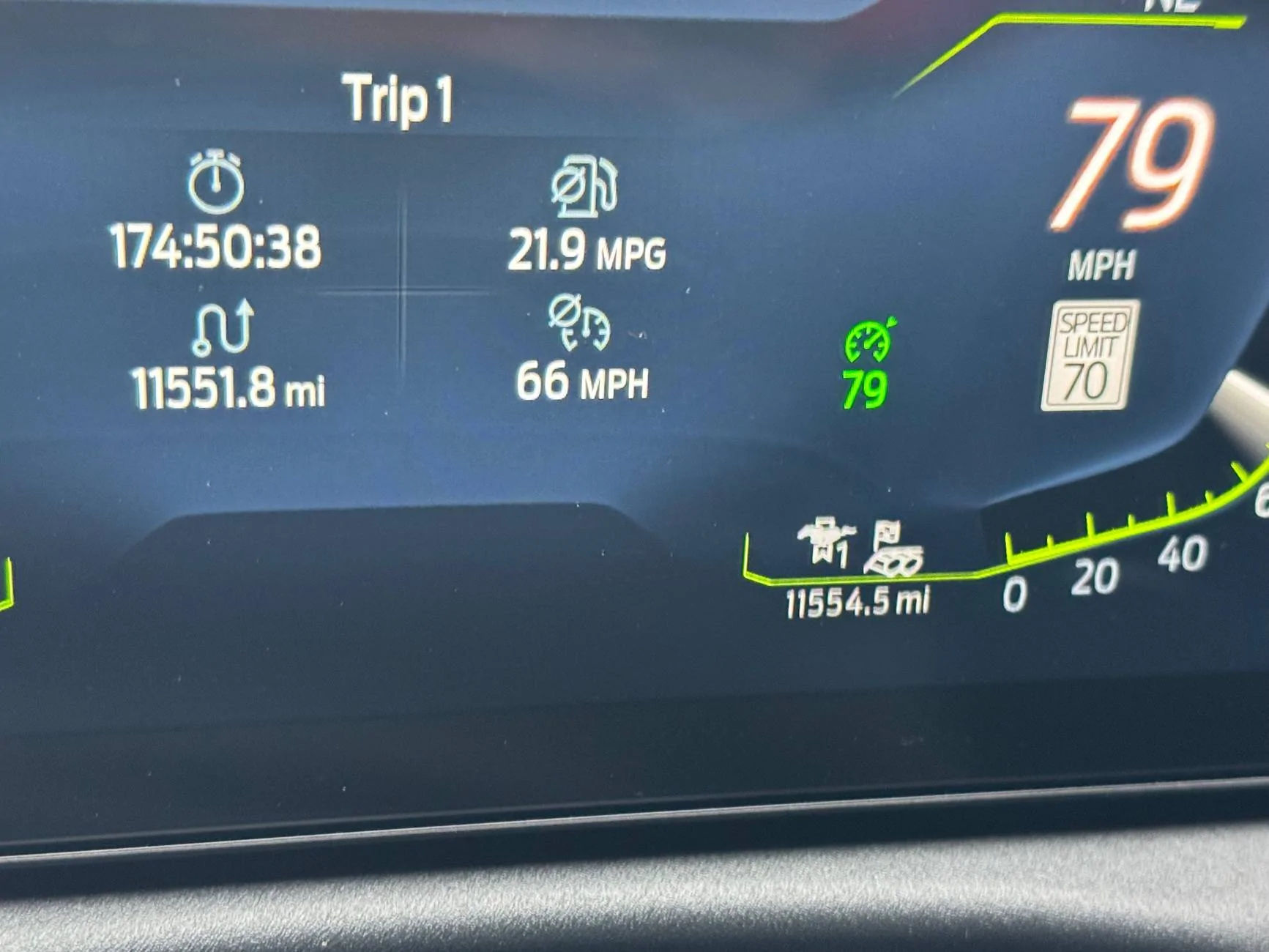
Here’s another data point: probably 85% hwy miles and I do not baby it. 22mpg at 11,500 miles all on 87 octane and it’s a 6spd.

S650 Mustang 87 Octane IMG_3001
Sponsored


robvas

Well-Known Member
Joined
Mar 7, 2024
Threads
26
Messages
2,750
Reaction score
2,729
Location
MI
Vehicle(s)
2011 Mustang
21mpg @ 66mph sounds perfectly normal

Octane isn't really going to affect mpg
 

Bikeman315

Well-Known Member
Joined
Apr 12, 2015
Threads
59
Messages
7,072
Reaction score
2,773
Location
Myrtle Beach, SC
Vehicle(s)
2019 Mustang GT/CS
This conversation is getting exhausting lol
Here’s another data point: probably 85% hwy miles and I do not baby it. 22mpg at 11,500 miles all on 87 octane and it’s a 6spd.
IMG_3001.jpeg
Honestly all these posts about gas mileage are exhausting. The difference between 87 and 91/93 has shown over and over again to be about 1 MPG (in favor of 91/93). So therefore, pointless. So it is and will aways be about performance and money. Pick your poison.
 

10basscat

Well-Known Member
Joined
Jun 29, 2023
Threads
6
Messages
169
Reaction score
285
Location
AL
Vehicle(s)
Mustang
Completely agree. I’d say I’ve saved close to $700 already and if I’m missing out on a few horsies I’d never know it based on how I use the car. Just giving another perspective.
 

89Trooper

Well-Known Member
Joined
Aug 19, 2014
Threads
17
Messages
1,242
Reaction score
266
Location
Central Florida
Vehicle(s)
2024 Mustang GT Premium
I also agree. I wasn’t showing my MPG, I was showing my average MPH.

Not sure where you all are able to drive your cars all the time like you’ve stole them, but I’m saving tons of money and I’m not missing out on any HP by using 87.

When I start road racing or drag racing, I’ll switch to 93.


So0_NaSTy

Well-Known Member
Joined
Oct 25, 2024
Threads
21
Messages
334
Reaction score
110
Location
NY
Vehicle(s)
2024 Ford Mustang GT Premium
I also agree. I wasn’t showing my MPG, I was showing my average MPH.

Not sure where you all are able to drive your cars all the time like you’ve stole them, but I’m saving tons of money and I’m not missing out on any HP by using 87.

When I start road racing or drag racing, I’ll switch to 93.
I’ve contemplated using 87 on road trips or whatever to save some money per fill, but honestly, the price difference I don’t know if I can justify “not giving the engine the best”. Ford says 87 100% works no issue, but no doubt 93 is better for overall engine health. My car since it was built for me and since I purchased it, hasn't seen 87 (except maybe if the factory did a light fill on it..) so I don't know if it's worth starting now..
 

So0_NaSTy

Well-Known Member
Joined
Oct 25, 2024
Threads
21
Messages
334
Reaction score
110
Location
NY
Vehicle(s)
2024 Ford Mustang GT Premium
This conversation is getting exhausting lol
Here’s another data point: probably 85% hwy miles and I do not baby it. 22mpg at 11,500 miles all on 87 octane and it’s a 6spd.

IMG_3001.jpeg
I probably need to reset my MPG. Because it’s been at 15.0 MPG for a while, so even on the highway it doesn't really fluctuate. I probably need to give it a reset on the highway for a true measurement. But i do know these 3.55 gears at higher speeds suck at fuel economy.
 

Pony2015

Member
Joined
Feb 4, 2025
Threads
0
Messages
8
Reaction score
12
Location
Sunnyvale, CA
Vehicle(s)
2015 GT 50yr Limited Manual Wimbledon White
The 87 vs 93 octane question comes up frequently - I have the lower compression Gen 2 Coyote (2017 GT), and originally used 87 octane, but now 91. VERY detailed rationale below:
  1. The octane rating quantifies a fuel’s resistance to auto-ignition (knock) under compression. It is unrelated to its burn rate, though the two can sometimes correlate depending on blend chemistry (LINK). Detonation (technical term for knock) occurs when unburned end-gas ahead of the normal flame front spontaneously ignites due to pressure and temperature rise after spark initiation (LINK). Of note, this is different than pre-ignition (combustion occurs BEFORE spark), which is much more destructive (but has causes NOT related to octane rating).
  2. Higher-octane fuel formulations achieve greater knock resistance through blend chemistry and additives, and possibly through a higher percentage of iso-octane (although likely a minor contributor in modern fuels). The energy content per gallon can differ slightly depending on ethanol content and blend composition, but for practical purposes, the energy content between, say, 87 versus 93 octane, is essentially the same. Therefore, the advantage of higher octane rating is the resistance to compression-related detonation (LINK), not higher energy content. And theoretically, it should not change mpg. But in reality, it can as described below.
  3. Detonation (knock) occurs under conditions of high compression after spark. Conditions increasing susceptibility to detonation:
    • High inherent compression ratio (characteristic of the engine)
    • Boost (characteristic of the engine)
    • High engine load (controlled by driver)
  4. High load increases cylinder pressure and temperature during combustion (which raises knock tendency) because it harder to relieve the pressure created by combustion due to resistance from the piston. High load occurs when towing, going uphill in too high a gear, or “lugging” by trying to accelerate at too low RPM. All of these driver-induced actions make it harder to push the piston down to relieve pressure in the combustion chamber, thus increasing temperature and the degree and duration of pressure post ignition (and thus susceptibility to detonation).
  5. High load is generally a LOW RPM phenomena. This seems counterintuitive because HP is greatest at high RPM. However, knock risk is often highest at low RPM and high load because cylinder pressure remains high for longer durations before the piston moves down. At high RPM, the reduced time for heat absorption can actually reduce knock tendency.
  6. Moreover, the actual force on the piston PER REVOLUTION is less at high RPM because that force is proportional to the HP divided by the RPM. Using a bicycle analogy, the force on your knees and the pedal is much greater when starting in a high gear compared to a low gear, even though the power to the wheels can be greater in the lower gear. The power you exert pedaling gets divided by pedal RPM to get force to the pedal, where whereas the power to the wheel does not.
  7. That said, even though knock is usually a low-RPM issue, sustained high-RPM wide-open-throttle can raise intake and cylinder temperatures enough to trigger borderline detonation or over-temperature protection (limp mode)—especially on 87 octane. I have had this happen twice on 87 octane, and so I switched to 91 octane, with no problems since. Higher-octane fuel restores knock margin and prevents ECU timing pull or limp mode. If you are pushing the engine hard, then my personal experience is to move to 91 or higher octane, even for the Gen 2 Coyotes.
  8. Modern engines (including Coyote) have sensors that detect knock as specific frequency vibrations, then communicate with the ECU, which then retards/delays ignition (spark) within milliseconds to prevent further knocking. This adjustment is RPM dependent (greatest delay for low RPM where risk for knocking is greatest). Delaying the spark allows combustion to occur later into the down stroke where pressure is relieved as piston moves down – and lower pressure during combustion means less likelihood of compression-related detonation -- and also higher exhaust gas temp (stressing exhaust components) because less energy is converted to useful work.
  9. ECU adjustment of the spark timing is driver dependent. If you are constantly lugging the engine at low RPM, the ECU must introduce a greater delay in spark at low RPM to prevent knocking. Also, unless you are intentionally trying to lug the engine, there will be no damage to the engine by using 87 octane, as long as the engine is rated for it – the engine can compensate. Overall, occasional light knock that immediately triggers ECU correction is not harmful, but sustained or frequent knock mile after mile will eventually ruin the engine.
  10. While delaying the spark reduces knocking, it also reduces engine efficiency. When combustion occurs further into the down stroke, there is more space already created for the expanding gases from the delayed combustion leading to less pressure, and thus less force on the piston – and less time to exert that force as piston has already completed part of its travel down. So using 87 octane under conditions of low RPM and high load can reduce HP -- however, this reduction in efficiency may not apply to higher RPM driving.
  11. So, while theoretically 87 and 93 octane gas have similar energy content and should yield similar mpg, there are conditions where mpg may suffer somewhat with 87 octane, some of these are characteristic of the engine and some are driver dependent (see items #3 and #4 above). If you have an NA gen 2 coyote, 87 will work just fine unless intentionally lugging or aggressive/WOT driving (87 is even recommended in the manual). If you have a higher compression Gen 3 or are boosted, octane rating may be more important (the manual for Gen 3 has 87 as the minimum, not the recommended). Of note, while Gen 3 has higher compression, the Gen 3 also has direct injection, which lowers the temperature of the air/gas "charge" (especially for gas/ethanol blends), and thus might partially (but not completely) offset the potential for knock from the higher pressure - see this LINK. For any engine, if you are a driver lugs the engine by placing high load on the engine at lower RPM you will see the most gain in power and mpg from higher octane gas -- you'll still stress your engine (just lowered potential for detonation-related damage by using higher octane). If you accelerate normally, or even do strong acceleration (but keep at higher RPMs), you probably won't see much improvement in HP or mpg for 93 versus 87 for an NA engine – it is the towing, lugging, low RPM pulls, where most benefit is seen (especially with boost). And even if you do see some mpg improvement, it may not be enough to offset the higher fuel cost (see item 13 below).
  12. Keep in mind that when changing 93 to 87, engine detects knock quickly and adjusts. When going from 87 to 93, it may a few drive cycles for the engine to recognize and then adjust to the new fuel. Of note, the US uses the more conservative (R+M)/2 method, which will be lower then the RON method used in many other countries (LINK) - so 87 in the US translates to even higher octane rating in countries using the RON method - more confidence that 87 will be OK in the US. Also, at high altitude with less dense air, each combustion event involves less air and fuel, reducing cylinder pressure and temperature. That lowers the tendency for knock, so engines can operate safely on lower octane fuel. So overall, 87 may be less of a concern at high altitude. Finally, it seems well established that higher inlet air temperature is consistently associated with potential for knock (see LINK for example). So if living in a colder climate, more confidence 87 will be OK, and in a very hot climate, a higher octane gas may be better justified.
  13. Car and Driver tested low versus high octane -- the biggest difference in driving performance was felt for the lower RPM higher torque F150 boosted truck (but mpg difference still not that great), with minimal driving improvement for the NA Dodge charger and for other boosted cars tested, somewhat consistent with the thinking above (LINK). And none of the differences in mpg justified the cost of premium. Of note, it's not 100% clear if ECU was allowed to fully adjust to the new fuel for some of these tests, but assuming it was, interesting results!
Always welcome suggestions, corrections, comments on anything written above!
 
Last edited:
Joined
Oct 15, 2023
Threads
0
Messages
9
Reaction score
4
Location
Renton, WA
Vehicle(s)
56 Sunliner, 65 Cyclone, 66 Fairlane, 67 Mustang, 67 Ranchero, 84 Harley, 99 Cob
Might as well buy the supercharger if buying the high octane, but its running great on 87.
I was happy keeping the front end a little lighter on this car.
 

Sofa King

Well-Known Member
Joined
Jul 14, 2023
Threads
12
Messages
1,624
Reaction score
1,704
Location
In a VAN down by the river
Website
youtu.be
Vehicle(s)
2024 Ecoboost, Vapor Blue, HPP
How you guys are getting like 24-26 MPG is astonishing. Maybe I need to reset my MPG, but with 93 I’m stuck at a solid 13.9.
Maybe your right foot is bigger...
 

So0_NaSTy

Well-Known Member
Joined
Oct 25, 2024
Threads
21
Messages
334
Reaction score
110
Location
NY
Vehicle(s)
2024 Ford Mustang GT Premium
Maybe your right foot is bigger...
Lmao I mean, I think I worded it incorrectly. When on cruise control, I’m hovering around probably 30 normally, but my MPG Average isn’t increasing much, again most likely because of my constant street driving. However due to gearing, if I’m on cruise control at 80 mph, it tends to hover around 20 or so mpg.
Sponsored


Top