Sponsored

Higher Oil Temps After Sw Update??

OP
OP

MidLifeCoyote

Well-Known Member
Joined
Oct 29, 2024
Threads
12
Messages
80
Reaction score
55
Location
Peoria Illinois
Vehicle(s)
2024 Mustang GT
@MidLifeCoyote I did not notice a difference in my oil temps today after the update. It was 106⁰ in Phoenix today. I'm still running around 206⁰-212⁰ oil temps during normal cruising. If I get "spirited" it goes up several degrees and then drops back down.

I got to say this theory that running the AC somehow lowers oil temps is both interesting and bizarre.
I'm sure with AC on, they bump up the fans to a higher speed for underhood temp concerns for things like wiring harnesses and component temps for electric components. This lowers head temp and more air across the radiator.

They just had an input condition messed up on cars like mine and it ran the higher speed maps all the time. Probably not on all cars but enough to package it into a priority SW update.

That would also explain the large oil temp delta reported across members cars on the multiple threads on this forum. Compound that with PP oil coolers and thats why the range is 195 to 230.
Sponsored

 
OP
OP

MidLifeCoyote

Well-Known Member
Joined
Oct 29, 2024
Threads
12
Messages
80
Reaction score
55
Location
Peoria Illinois
Vehicle(s)
2024 Mustang GT
PP cars also have a much thicker radiator and fans that push 500 CFM more … helping to lower coolant and head temps.
Very true.

Thank you for the info on the AC, I think my theory about the PCM update resetting my car off of the AC on maps all the time is what's going on. I will be curious to see if other people notice this when they update. Its probably a small but note worthy part of the population.

Engine health wise, for a dialy driver like me, having oil up in the 220 to 230 range is probably better than 200 to 215 range to get fuel, oil, and contaminats out of the oil.


OP
OP

MidLifeCoyote

Well-Known Member
Joined
Oct 29, 2024
Threads
12
Messages
80
Reaction score
55
Location
Peoria Illinois
Vehicle(s)
2024 Mustang GT
Probably best to display one of the other sets of gages to not drive your self crazy…lol

If the coolant temps rise, then you can start worrying. Until then, just drive and enjoy the car.
This really is a case of giving the consumer too much information. Other than displaying that algorithm, there is literally nothing else indicating a change in engine behavior. This is probably good advice.
 

AZ_Ryan

Well-Known Member
Joined
May 31, 2016
Threads
32
Messages
3,402
Reaction score
4,670
Location
Arizona
Vehicle(s)
2024 GT Premium
This really is a case of giving the consumer too much information. Other than displaying that algorithm, there is literally nothing else indicating a change in engine behavior. This is probably good advice.
I've been saying this over and over again. No one cared about oil temperatures on the S550s. Then the S650 puts a gauge in your face and all the sudden people are tripping out if it goes over 200⁰ and talking about oil coolers lol. Stop overthinking it and enjoy your car people. 😎
 

Deleted member 61195

Guest
I just did a 2000 mile road trip to Calif coast and back. I took off at 0900 and drove across the 113-115 degree desert heat at 75-85 and occasional 100mph burst. My oil temp hung around 214- 230. The cylinder head temp would fluctuate from 201 to 212 depending throttle input. Trans matched head temp. My Mustang is non pp. I was impressed how the car handled the extreme desert heat. The only stop was in Yuma for fuel and quick bite to eat before getting to day 1 destination in Oceanside.
 
Last edited by a moderator:

Skye

Well-Known Member
Joined
Jul 29, 2022
Threads
0
Messages
1,682
Reaction score
2,599
Location
≈39N
Vehicle(s)
"Skye" Mach1 N2144
Using the S550 as a reference...

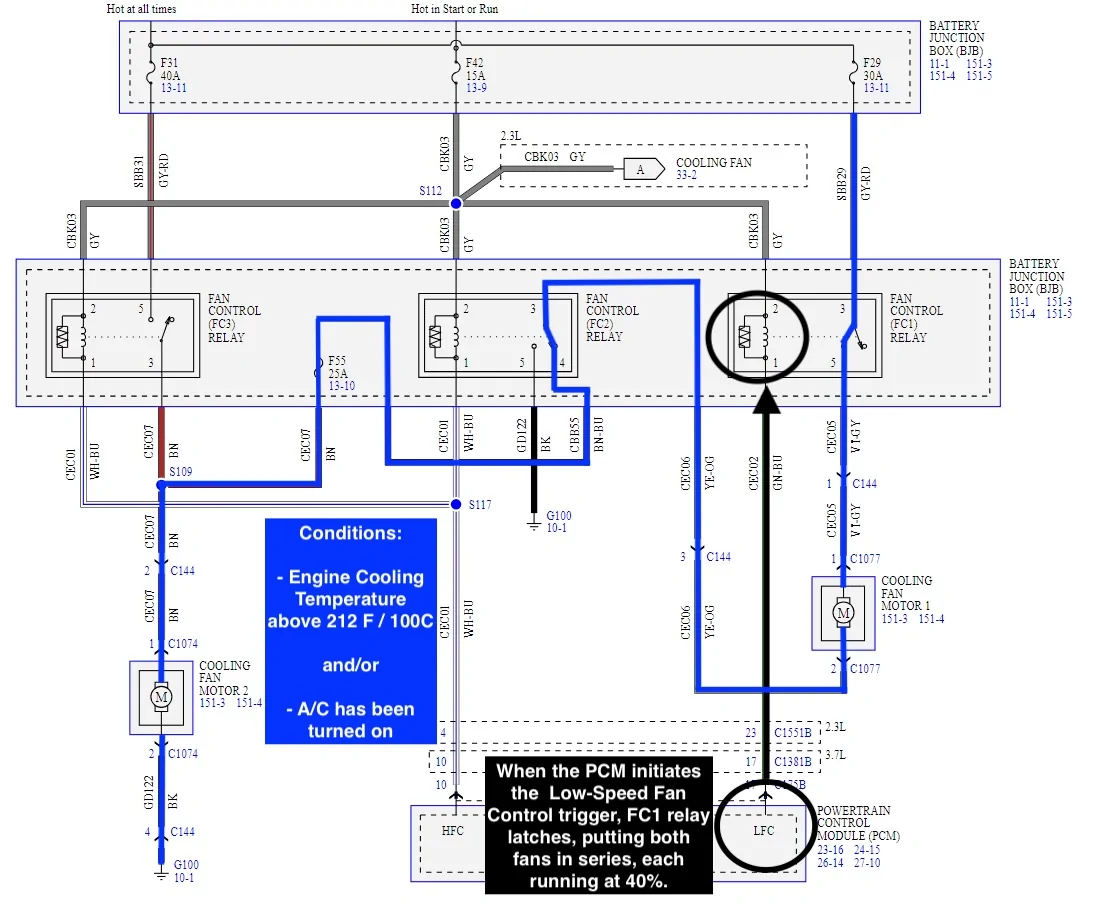
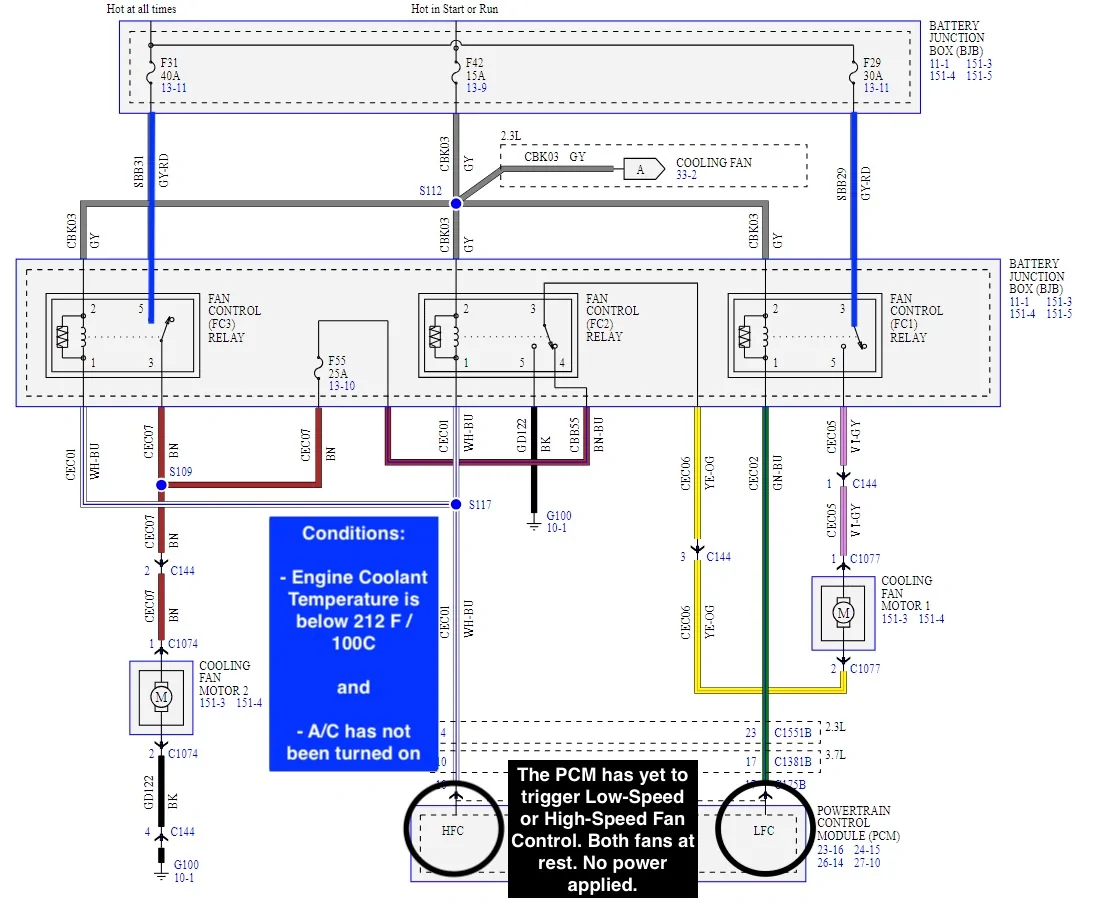
As to why operating the A/C generally results in cooler engine temperatures, that occurs due to the radiator fans. When the A/C is turned on, both radiator fans immediately begin operating at 40% power. If temperatures continue to increase to a given point, both will spin with 100% power.

The purpose of the fans engaging is two-fold: 1) to draw air across the A/C condenser, for better heat* transfer, 2) to keep the powertrain cooler (A/C condenser is now adding heat).

Why two fans? Fans are to a radiator as pixels are to a photo. The smaller the fan, the greater the coverage (higher resolution).

Why run both at the same time? More uniform cooling across the face of the radiator.

* There's not really hot and cold, but heat and less heat.

When it enters the low side of the A/C system, the liquid refrigerant expands into a gas; this process requires heat, the energy inside the interior of the car being the source. By turning from a liquid into a gas, the refrigerant absorbs that energy.

As the gas enters the high side of the A/C system, it's compressed back to a liquid. The heat taken from the interior now needs to be removed, the A/C condenser acting as a radiator, the fans hastening the heat transfer process.

By getting the liquid as dense as possible, it allows for the best energy transfer when it re-enters the evaporator core in the interior of the car.

It's the same process for many of us with a home system involving a compressor and fan outside. The evaporator core is inside the home, in the ducting. The compressor, condenser and fan is outside.

On a small scale, you can experience the same when holding "air in a can", using it and noticing how the can is cooler. On a grand scale, Liquid Natural Gas ships first super-chill, condense the product at the filling terminal, then later expand the product at the receiving port (very, very slowly). :giggle:


S650 Mustang Higher Oil Temps After Sw Update?? cooling fan speed ect trigger temps


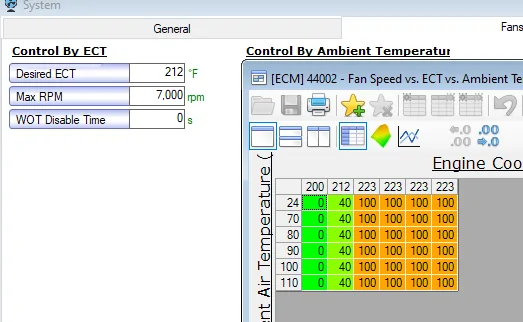
^ Chart of Engine Cooling Temperature parameters and fans, S550, above.

The Coyote has a Cylinder Head Temperature (CHT) sensor; this sensor rests in the back of the head, passenger side. The sensor itself is a thermistor. The resistance of the sensor changes with temperature, with any reference voltages then adjusting as a result. The CHT is what we see when viewing the in-dash display.

Some manufacturers will produce engines with Engine Coolant Temperature (ECT) sensors. These sensors rest in a coolant jacket and read liquid temperatures directly. The Coyote does not have an ECT sensor. In the Powertrain Control Module, software derives the ECT from the CHT. Fans are then turned on/off based on the ECT and other logic.

One can think of ECT as a raw reading at one point in time, while CHT is a measure of everything. ECT + engine load = CHT. ECT can be read with scanner/tuning tools and software. Under light loads, ECT/CHT could be pretty close to one another, while during more spirited driving, ECT/CHT could differ by as much as 10+ degrees, the ECT always being cooler.

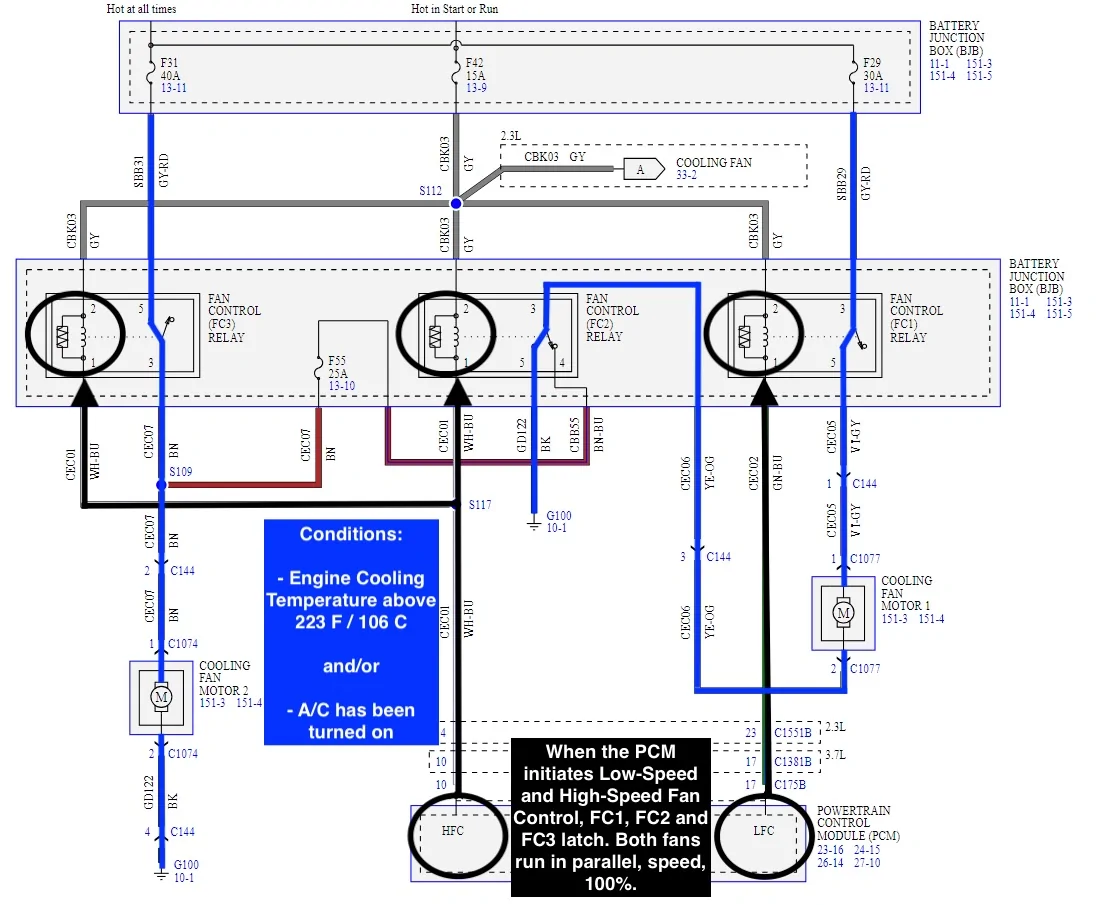
S650 Mustang Higher Oil Temps After Sw Update?? cooling fan schema high speed


S650 Mustang Higher Oil Temps After Sw Update?? cooling fan schema low speed


S650 Mustang Higher Oil Temps After Sw Update?? cooling fan schema no speed
 
Last edited:

Starship Enterprise

Well-Known Member
Joined
Jun 15, 2025
Threads
8
Messages
1,155
Reaction score
1,680
Location
MD
Vehicle(s)
2025 Mustang GT Premium
For a daily driver, it's likely moot, but some of us do auto-cross and other events where your oil temps can get pretty high.
Yup……Those are the ones who install oil coolers, catch cans and need to change their oil after one weekend of racing. That’s a whole ‘nuther level.
 

Junkyard Dog

Well-Known Member
Joined
Jun 3, 2025
Threads
54
Messages
2,560
Reaction score
2,059
Location
Georgia
Vehicle(s)
2024 Dark Horse
Using the S550 as a reference...

As to why operating the A/C generally results in cooler engine temperatures, that occurs due to the radiator fans. When the A/C is turned on, both radiator fans immediately begin operating at 40% power. If temperatures continue to increase to a given point, both will spin with 100% power.

The purpose of the fans engaging is two-fold: 1) to draw air across the A/C condenser, for better heat* transfer, 2) to keep the powertrain cooler (A/C condenser is now adding heat).

Why two fans? Fans are to a radiator as pixels are to a photo. The smaller the fan, the greater the coverage (higher resolution).

Why run both at the same time? More uniform cooling across the face of the radiator.

* There's not really hot and cold, but heat and less heat.

When it enters the low side of the A/C system, the liquid refrigerant expands into a gas; this process requires heat, the energy inside the interior of the car being the source. By turning from a liquid into a gas, the refrigerant absorbs that energy.

As the gas enters the high side of the A/C system, it's compressed back to a liquid. The heat taken from the interior now needs to be removed, the A/C condenser acting as a radiator, the fans hastening the heat transfer process.

By getting the liquid as dense as possible, it allows for the best energy transfer when it re-enters the evaporator core in the interior of the car.

It's the same process for many of us with a home system involving a compressor and fan outside. The evaporator core is inside the home, in the ducting. The compressor, condenser and fan is outside.

On a small scale, you can experience the same when holding "air in a can", using it and noticing how the can is cooler. On a grand scale, Liquid Natural Gas ships first super-chill, condense the product at the filling terminal, then later expand the product at the receiving port (very, very slowly). :giggle:


cooling fan speed ect trigger temps.png


^ Chart of Engine Cooling Temperature parameters and fans, S550, above.

The Coyote has a Cylinder Head Temperature (CHT) sensor; this sensor rests in the back of the head, passenger side. The sensor itself is a thermistor. The resistance of the sensor changes with temperature, with any reference voltages then adjusting as a result. The CHT is what we see when viewing the in-dash display.

Some manufacturers will produce engines with Engine Coolant Temperature (ECT) sensors. These sensors rest in a coolant jacket and read liquid temperatures directly. The Coyote does not have an ECT sensor. In the Powertrain Control Module, software derives the ECT from the CHT. Fans are then turned on/off based on the ECT and other logic.

One can think of ECT as a raw reading at one point in time, while CHT is a measure of everything. ECT + engine load = CHT. ECT can be read with scanner/tuning tools and software. Under light loads, ECT/CHT could be pretty close to one another, while during more spirited driving, ECT/CHT could differ by as much as 10+ degrees, the ECT always being cooler.

cooling fan schema high speed.jpg


cooling fan schema low speed.jpg


cooling fan schema no speed.jpg

That is all how I understand things to operate

BUT

Two posters above said this occurred while one drove steadily at 70 mph on the highway, and the other was driving across the desert to California at speeds of 80 - 100 mph.

The fans do not really matter anymore at those speeds, do they?
 

FASTback65

New Member
Joined
Jul 16, 2024
Threads
0
Messages
2
Reaction score
1
Location
Palo Alto, CA
Vehicle(s)
2024 GT
My oil temp seems to like to climb to 230F now and stay there (non PP GT). I guess it still would be nice to know why the engineers changed their minds about the ideal oil temp. Makes me wonder why go through the trouble of creating an update if it was supposedly ok before
Sponsored


Top