Sponsored

Ford Performance Camber Plates & Alignment

GhastlyTT

Well-Known Member
Joined
Mar 18, 2024
Threads
13
Messages
279
Reaction score
405
Location
Hampton, VA
Vehicle(s)
'24 Dark Horse, '25 F-150, '23 Mach-E GT, '24 R1250GSA, '17 S1000RR
Camber negative or positive is the #1 tire wear reason.
This is wrong and illogical. Bad toe causes constant surface scrub as the tires are continuously trying to push inward or outward depending on offset from 0. Camber simply reduces the contact patch in a straight line and has no effect on rolling resistance. Camber does cause UNEVEN wear IF the driver doesn't use the negative camber for its intended purpose: allowing additional road contact and thus more traction during hard cornering.
Sponsored

 
OP
OP
Edson8r

Edson8r

Well-Known Member
Joined
Sep 9, 2023
Threads
10
Messages
206
Reaction score
238
Location
Dallas, TX
Vehicle(s)
2024 Ford Mustang GT
This is wrong and illogical. Bad toe causes constant surface scrub as the tires are continuously trying to push inward or outward depending on offset from 0. Camber simply reduces the contact patch in a straight line and has no effect on rolling resistance. Camber does cause UNEVEN wear IF the driver doesn't use the negative camber for its intended purpose: allowing additional road contact and thus more traction during hard cornering.
Okay that’s what I had read during my research phase before I took it to the dealer. Luckily they were able to refund me the full amount without much hassle.
 

Junkyard Dog

Well-Known Member
Joined
Jun 3, 2025
Threads
54
Messages
2,560
Reaction score
2,059
Location
Georgia
Vehicle(s)
2024 Dark Horse
Ford says -1.03 for street and -1.5 for track (front) and -1.5 for rear regardless of which use.

For the Dark Horse handling package -1.21 for street and -2.25 for track (front), rear is -1.5 for track but oddly changes for the street to -1.14


Two observations: (1) Never ever ever ever set your camber to 0° for a Mustang unless you never intend to turn your steering wheel. (2) with some sticky tires you could probably have a much better track day with that front alignment at more like -3° or -3.5° if you are going to push it through the turns.
 

Junkyard Dog

Well-Known Member
Joined
Jun 3, 2025
Threads
54
Messages
2,560
Reaction score
2,059
Location
Georgia
Vehicle(s)
2024 Dark Horse
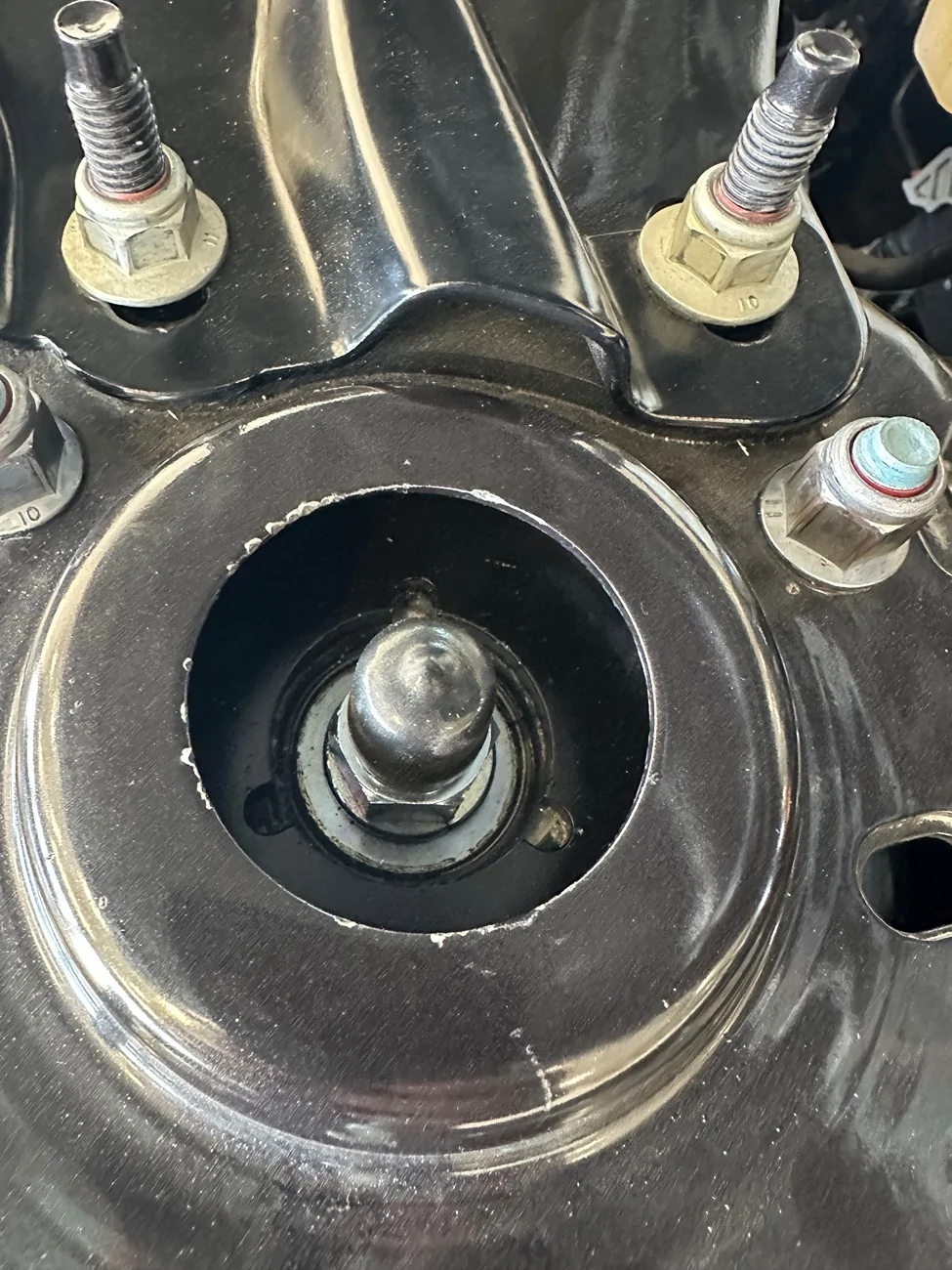
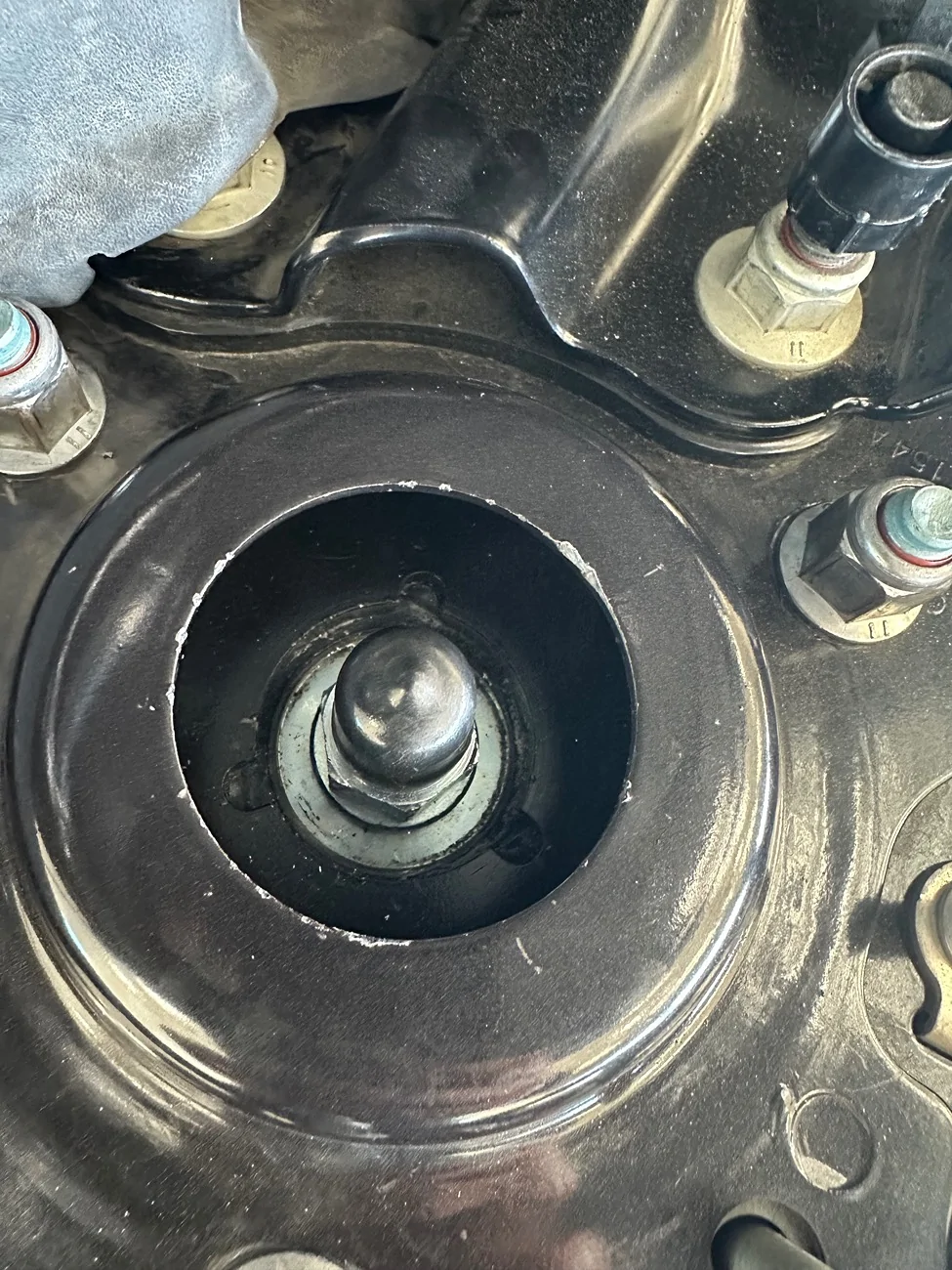
Thanks everyone! I know they didn’t touch camber especially since they couldn’t give me an answer as to how they tried to adjust it. They “tried” but all they did was bang it up trying to pry it or something. I knew they didn’t even loosen the bolts. Luckily there’s two shops that could get me squared away. Thought I’d give the dealer a chance but that was my mistake.
IMG_7761.webp
IMG_7762.webp

Shouldn't those be slammed all the way over to the edge of that large, uncut hole?


Junkyard Dog

Well-Known Member
Joined
Jun 3, 2025
Threads
54
Messages
2,560
Reaction score
2,059
Location
Georgia
Vehicle(s)
2024 Dark Horse
Starting at about 40 seconds, Vorshlag shows us some tricks for camber, but they do not reveal how they got their knob under the top of the strut tower sheet metal so that they could add more negative camber without cutting the strut tower hole . . .


Ryunker

Well-Known Member
Joined
Apr 2, 2023
Threads
21
Messages
589
Reaction score
728
Location
Madison South Dakota
Vehicle(s)
2013 convertible, 1971 Mach1, 2024 DH 700A
Ford says -1.03 for street and -1.5 for track (front) and -1.5 for rear regardless of which use.

For the Dark Horse handling package -1.21 for street and -2.25 for track (front), rear is -1.5 for track but oddly changes for the street to -1.14


Two observations: (1) Never ever ever ever set your camber to 0° for a Mustang unless you never intend to turn your steering wheel. (2) with some sticky tires you could probably have a much better track day with that front alignment at more like -3° or -3.5° if you are going to push it through the turns.
Car drives wonderful on the street with zero issues at zero camber, yes for track days would be a different story.
 

Ryunker

Well-Known Member
Joined
Apr 2, 2023
Threads
21
Messages
589
Reaction score
728
Location
Madison South Dakota
Vehicle(s)
2013 convertible, 1971 Mach1, 2024 DH 700A
This is wrong and illogical. Bad toe causes constant surface scrub as the tires are continuously trying to push inward or outward depending on offset from 0. Camber simply reduces the contact patch in a straight line and has no effect on rolling resistance. Camber does cause UNEVEN wear IF the driver doesn't use the negative camber for its intended purpose: allowing additional road contact and thus more traction during hard cornering.
Toe will affect wear, just camber is #1, toe coming in second. When you have camber other than zero (sometime preferred) the weight of the car is not centered on the tires, the weight of the car is off to one side always causing consistent tire wear on that side which is why it is #1.
 

GhastlyTT

Well-Known Member
Joined
Mar 18, 2024
Threads
13
Messages
279
Reaction score
405
Location
Hampton, VA
Vehicle(s)
'24 Dark Horse, '25 F-150, '23 Mach-E GT, '24 R1250GSA, '17 S1000RR
Toe will affect wear, just camber is #1, toe coming in second. When you have camber other than zero (sometime preferred) the weight of the car is not centered on the tires, the weight of the car is off to one side always causing consistent tire wear on that side which is why it is #1.
You must only drive in a straight line because you think rolling resistance is more destructive than lateral load. There is a reason all trims of Mustang have negative camber as factory specification. Agree to disagree.
 

Junkyard Dog

Well-Known Member
Joined
Jun 3, 2025
Threads
54
Messages
2,560
Reaction score
2,059
Location
Georgia
Vehicle(s)
2024 Dark Horse
Car drives wonderful on the street with zero issues at zero camber, yes for track days would be a different story.
It cannot possibly turn well.

If you put any sort of lateral G force on your car, the car will start to roll. That is just physics. When your car starts to roll, and you have a 0° camber setting when the wheel is static (is this serious or are you just trolling us?), then your tire's relationship to the road changes. It is no longer 0° of camber. The tire will have a positive camber setting in relation to the car, and the outside tire, the one taking the majority of the weight (remember, the lateral G force causes your center of gravity to move, so the outside tire tread now takes more of the weight) is now rolling onto the outside shoulder. The tread is no longer flat against the asphalt as it was when you were cruising down the road in a straight line.

How could this ever be a desirable situation when turning your steering wheel?

Whether you are taking an enjoyable drive through the hills or making an evasive maneuver to avoid a horrible crash on the interstate on your way to work, having the outside tire go into positive camber is not a desirable thing. It is the opposite of what you want to happen.

The harder the turn, that is, the more desperately you need to change directions, the worse that 0° camber setting is going to be.
 
Last edited:

Junkyard Dog

Well-Known Member
Joined
Jun 3, 2025
Threads
54
Messages
2,560
Reaction score
2,059
Location
Georgia
Vehicle(s)
2024 Dark Horse
When a vehicle with 0 degrees (neutral) camber turns, body roll and lateral forces cause the outside tire to tilt outward, resulting in positive camber. This reduces the contact patch, leading to decreased cornering traction, poor handling, and increased wear on the outside edge of the tire.
Key Effects of 0∘ Camber in a Turn:
  • Reduced Traction: As the tire loses its flat contact with the road, the outside tire handles the load poorly, reducing grip.
  • Increased Tire Wear: The outer edge of the tire bears most of the load, causing uneven wear.
  • Understeer: The reduced front grip often leads to the car understeering (pushing the front end).
  • "Roll Over": Due to suspension compression, the tire tends to "roll over" onto its sidewall rather than staying flat, particularly on the outside tire.
To counteract this, many vehicles, especially performance cars, use negative camber (tops of wheels tilted inward) so that when the car rolls in a turn, the tire becomes flush with the road.
S650 Mustang Ford Performance Camber Plates & Alignment 1769207721590-i0
S650 Mustang Ford Performance Camber Plates & Alignment 1769207721607-v1


https://www.google.com/search?client=safari&rls=en&q=what+happens+to+0°+camber+in+a+turn&ie=UTF-8&oe=UTF-8
 
Last edited:

Ryunker

Well-Known Member
Joined
Apr 2, 2023
Threads
21
Messages
589
Reaction score
728
Location
Madison South Dakota
Vehicle(s)
2013 convertible, 1971 Mach1, 2024 DH 700A
It cannot possibly turn well.

If you put any sort of lateral G force on your car, the car will start to roll. That is just physics. When your car starts to roll, and you have a 0° camber setting when the wheel is static (is this serious or are you just trolling us?), then your tire's relationship to the road changes. It is no longer 0° of camber. The tire will have a positive camber setting in relation to the car, and the outside tire, the one taking the majority of the weight (remember, the lateral G force causes your center of gravity to move, so the outside tire tread now takes more of the weight) is now rolling onto the outside shoulder. The tread is no longer flat against the asphalt as it was when you were cruising down the road in a straight line.

How could this ever be a desirable situation when turning your steering wheel?

Whether you are taking an enjoyable drive through the hills or making an evasive maneuver to avoid a horrible crash on the interstate on your way to work, having the outside tire go into positive camber is not a desirable thing. It is the opposite of what you want to happen.

The harder the turn, that is, the more desperately you need to change directions, the worse that 0° camber setting is going to be.
As I stated before, negative camber is likely desirable, with the offset of increased wear. My statements are just factual. In my DH camber is set to damn near zero and have put on just under 9k miles with no issues. I agree if I was driving this car had and towards its limits, yes I would do different alignment specs, but daily driving there for sure is no issues.
 

Westphal

Well-Known Member
Joined
Sep 29, 2025
Threads
2
Messages
215
Reaction score
286
Location
Maryland
Vehicle(s)
2026 GT Adriatic Blue convertible, 2005 Pontiac GTO
On my '87 Camaro (almost 20 years) and '05 GTO (11 years), I got my best even tire wear at about 1 deg. of negative camber. Any less and it wore the outside edge of the front tires faster. I put 10k miles/year on my car, so that's a lot of tire miles. Best all-season tires I've had for performance and wear are the Continental ExtremeContact DWS line, getting about 40k miles on a set of tires, and I drive it hard at times and the occasional burnout.
Sponsored


Top