MustangMitch69
Well-Known Member
- Thread starter
- #1
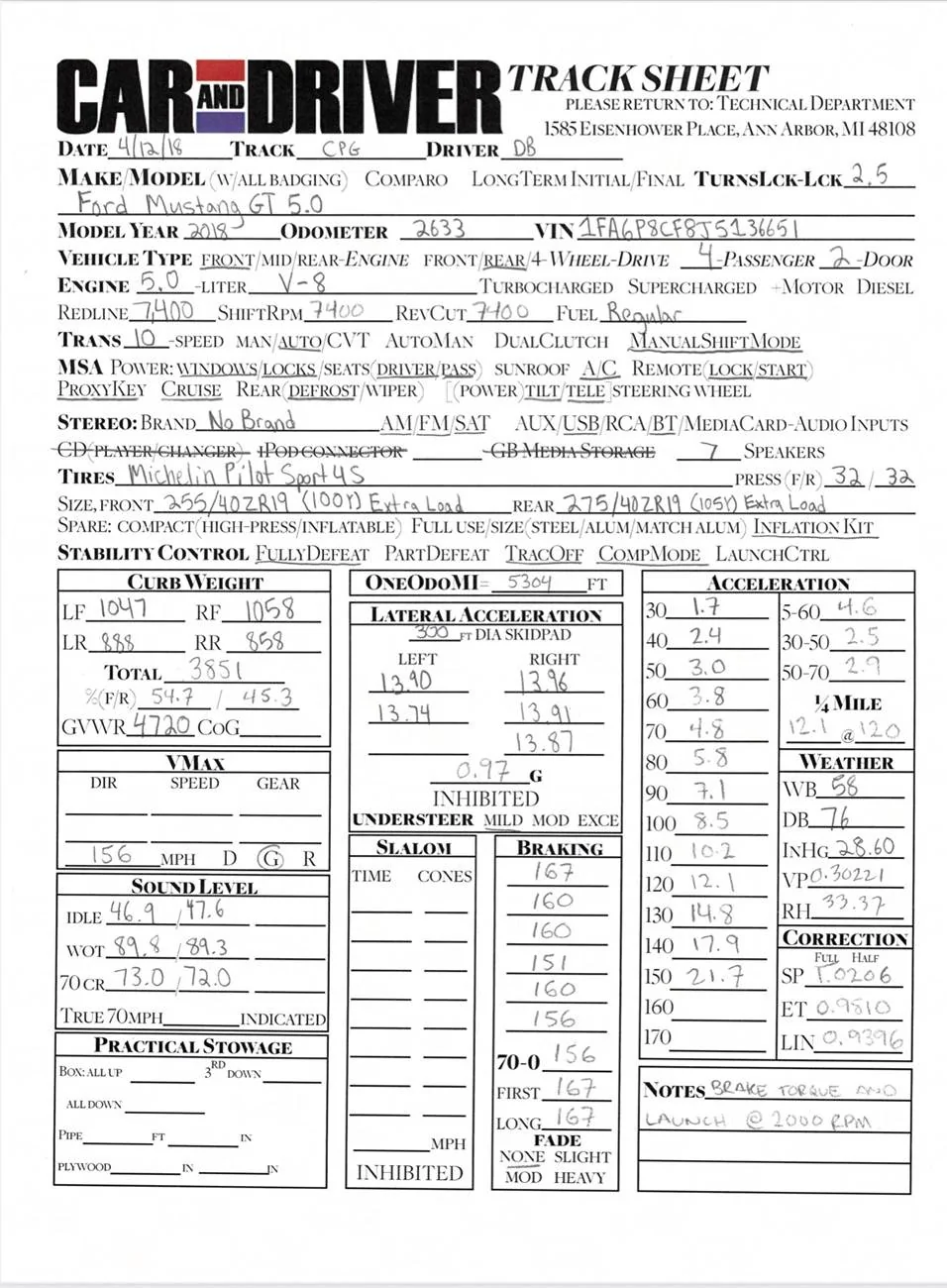
Out of curiosity I asked the latest AI model that I've been using to estimate how long it would take my GT vert to hit 150, which is my understanding of the electronic limit, and here is what it said.
I'm curious how accurate this might be and also how different this might be for the dark horse, for boosted coyotes, and soon for tuned coyotes.
"Approximately 0.7 miles and 24 seconds.
To arrive at this solution, performance estimates for the 2025 Ford Mustang GT convertible (automatic transmission) were sourced from a reliable automotive database that uses simulation models to derive acceleration figures based on the vehicle's specifications (e.g., 486 horsepower, approximately 4,000-pound curb weight). These include discrete time points to reach various speeds up to 150 mph:
0 mph at 0 s
20 mph at 1.2 s
30 mph at 1.6 s
40 mph at 2.1 s
50 mph at 2.9 s
60 mph at 3.7 s
70 mph at 4.8 s
80 mph at 5.9 s
90 mph at 7.4 s
100 mph at 8.9 s
110 mph at 10.9 s
120 mph at 13.1 s
130 mph at 15.8 s
140 mph at 19.2 s
150 mph at 23.7 s
The time is directly 23.7 seconds, rounded to approximately 24 seconds.
For the distance, the trapezoidal rule was applied to numerically integrate over these segments: for each interval from speed \(v_1\) to \(v_2\) over time difference \(\Delta t\), the distance increment is \(\frac{(v_1 + v_2)}{2} \times \Delta t / 3600\) miles (converting mph and seconds to miles). Summing these yields approximately 0.68 miles, rounded to 0.7 miles."
I'm curious how accurate this might be and also how different this might be for the dark horse, for boosted coyotes, and soon for tuned coyotes.
"Approximately 0.7 miles and 24 seconds.
To arrive at this solution, performance estimates for the 2025 Ford Mustang GT convertible (automatic transmission) were sourced from a reliable automotive database that uses simulation models to derive acceleration figures based on the vehicle's specifications (e.g., 486 horsepower, approximately 4,000-pound curb weight). These include discrete time points to reach various speeds up to 150 mph:
0 mph at 0 s
20 mph at 1.2 s
30 mph at 1.6 s
40 mph at 2.1 s
50 mph at 2.9 s
60 mph at 3.7 s
70 mph at 4.8 s
80 mph at 5.9 s
90 mph at 7.4 s
100 mph at 8.9 s
110 mph at 10.9 s
120 mph at 13.1 s
130 mph at 15.8 s
140 mph at 19.2 s
150 mph at 23.7 s
The time is directly 23.7 seconds, rounded to approximately 24 seconds.
For the distance, the trapezoidal rule was applied to numerically integrate over these segments: for each interval from speed \(v_1\) to \(v_2\) over time difference \(\Delta t\), the distance increment is \(\frac{(v_1 + v_2)}{2} \times \Delta t / 3600\) miles (converting mph and seconds to miles). Summing these yields approximately 0.68 miles, rounded to 0.7 miles."
Sponsored