Sponsored

Steeda claims it, is it real world?

MustangMitch69

Well-Known Member
Joined
Aug 11, 2024
Threads
16
Messages
248
Reaction score
446
Location
Florida
Vehicle(s)
2024 Mustang GT
30 hp is a .2 or .3 reduction in e.t. and a 2-3 mph gain.

That's significant.

Then add another 30.

And another . . .

🤣
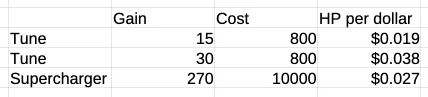
That makes sense, and I understand why people do it as a hobby, but after spending so much on incremental marginal improvement performance mods, it seems a supercharger that cuts 60-130 time in half is more bang for the buck.
Sponsored


Junkyard Dog

Well-Known Member
Joined
Jun 3, 2025
Threads
59
Messages
2,862
Reaction score
2,372
Location
Georgia
Vehicle(s)
2024 Dark Horse
That makes sense, and I understand why people do it as a hobby, but after spending so much on incremental marginal improvement performance mods, it seems a supercharger that cuts 60-130 time in half is more bang for the buck.
Depends on your goals.

I bought my Dark Horse to drive around to the grocery store. I also bought it to run on the track.

Adding a supercharger ruins the car for the track, because the car cannot come close to cooling off the heat produced by 875 horsepower (and no, I am not talking about IAT, I mean actual heat produced by the engine, BTU per horsepower, a huge chunk of which goes into the coolant and oil and has to be transferred to the air). It's not much fun doing one or two laps and then cruising along to cool off the engine.

Oil can be controlled pretty effectively with the aftermarket (the stock oil cooler won't cut it with a supercharger).

Coolant, however, cannot, at least not without major fabrication. Kenny G and Fluidyne, for instance, have S550 triple pass radiators, but not for the S650 (just like Ferodo does not make brake pads for the S650 yet). Maybe in the near future they will address this potential market.

Then I would probably go with turbos instead of a supercharger for the track, anyway, not driven off the crank, so more horsepower per psi, meaning less heat from compressed air transferred into the rings at the same horsepower level . . . and easier to turn down the boost from the driver's seat, too (although the Smoothboost controller may solve this for superchargers). And the rings are a worry if you are on a race track for 30 minutes with 4000-5000 foot full throttle runs over and over and over instead of a quarter mile and go cool down. This is why the forced induction short block has wider gaps in the rings.
 
Last edited:
OP
OP
Achlys

Achlys

Well-Known Member
Joined
May 31, 2026
Threads
7
Messages
113
Reaction score
194
Location
KC Metro
Vehicle(s)
2026 Mustang GT Premium 401A, A10, 3.55, AE, Bronco Sport Badlands Sasquatch
I don't doubt these mods legitimately increase both, but I'm skeptical of whether many people actually feel a difference rsther than just justifying to themselves why they spent the $ and modding something for modding's sake.

These aren't 4-cylinder honda civics from the 90's and early 2000's where a 30 hp gain is more than 10%.
[/QUOTE]

Yeah, I'm that guy.

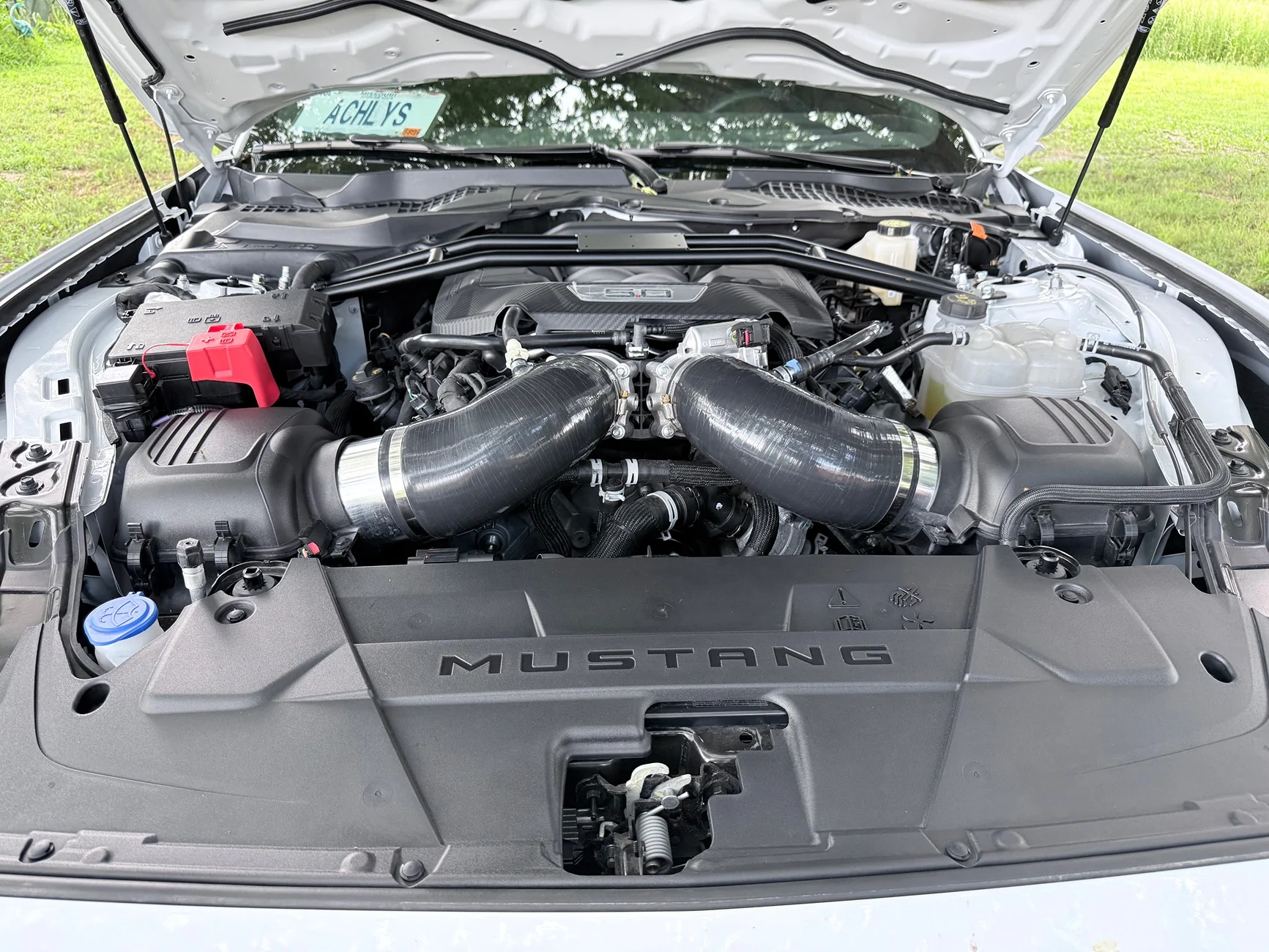
Steeda claims increased power; my seat is old, so I'm skeptical of " feeling it. " .For me, it was completely a cosmetic choice. I didn't mod to mod; I modded to please my eyes.

S650 Mustang Steeda claims it, is it real world? IMG_3038


OP
OP
Achlys

Achlys

Well-Known Member
Joined
May 31, 2026
Threads
7
Messages
113
Reaction score
194
Location
KC Metro
Vehicle(s)
2026 Mustang GT Premium 401A, A10, 3.55, AE, Bronco Sport Badlands Sasquatch
I have to admit that I think I am being infected with Mod-itus. Leaning toward a Borla X-Pipe Switchfire for my next "mod". Which is slowly "itching" me toward getting it tuned. Damn the infection is REAL! The whole reason I started the thread.
 

NegativeMultiplier

Well-Known Member
Joined
Oct 24, 2022
Threads
9
Messages
536
Reaction score
575
Location
-
Vehicle(s)
-
Should be better than that. But their tunes are for the masses, probably 91 octane optimized. I dont blame them. But honestly should be able to do better gains wise with a real custom tune. Nothing against Steeda.
What do you suppose one could make on a PP GT with a proper 93 tune?
 

D/\rK•650

Well-Known Member
Joined
Aug 8, 2025
Threads
20
Messages
926
Reaction score
689
Location
California
Vehicle(s)
2025 Mustang DarkHorse
Depends on your goals.

I bought my Dark Horse to drive around to the grocery store. I also bought it to run on the track.

Adding a supercharger ruins the car for the track, because the car cannot come close to cooling off the heat produced by 875 horsepower (and no, I am not talking about IAT, I mean actual heat produced by the engine, BTU per horsepower, a huge chunk of which goes into the coolant and oil and has to be transferred to the air). It's not much fun doing one or two laps and then cruising along to cool off the engine.

Oil can be controlled pretty effectively with the aftermarket (the stock oil cooler won't cut it with a supercharger).

Coolant, however, cannot, at least not without major fabrication. Kenny G and Fluidyne, for instance, have S550 triple pass radiators, but not for the S650 (just like Ferodo does not make brake pads for the S650 yet). Maybe in the near future they will address this potential market.

Then I would probably go with turbos instead of a supercharger for the track, anyway, not driven off the crank, so more horsepower per psi, meaning less heat from compressed air transferred into the rings at the same horsepower level . . . and easier to turn down the boost from the driver's seat, too (although the Smoothboost controller may solve this for superchargers). And the rings are a worry if you are on a race track for 30 minutes with 4000-5000 foot full throttle runs over and over and over instead of a quarter mile and go cool down. This is why the forced induction short block has wider gaps in the rings.
Does the ProCharger setup work better with less heat issues than the whipples ect? I think I've heard they work a bit better on track with regards to heat.
 

Junkyard Dog

Well-Known Member
Joined
Jun 3, 2025
Threads
59
Messages
2,862
Reaction score
2,372
Location
Georgia
Vehicle(s)
2024 Dark Horse
Does the ProCharger setup work better with less heat issues than the whipples ect? I think I've heard they work a bit better on track with regards to heat.
Whenever we talk about heat things start getting confused.

Most folks are talking about intake air temperatures. IAT. That is a product of compressing the air, and it is moderated by some sort of intercooler, usually. So folks will start talking about heat soak because one is on the engine and one is mounted off the engine and blah, blah, blah . . . they are missing the point entirely.

That is not the heat I am talking about.

I am talking about the heat produced in the engine. A 200 horsepower engine generates less heat than a 500 horsepower engine. That is why the radiator for the 200 horsepower engine is this tiny little thing, while the GT Perf Pack and Dark Horse have this bigger radiator.

There is a 300 horsepower difference between those two engines.

Now you propose to add more than another 300.

Do you see the issue?

2,545 BTU per hour for each horsepower generated. 65% - 80% of that heat is wasted. Some goes out the tail pipe. The rest of the wasted heat transfers into the metal of the engine and from there into the oil and the coolant.

Now you need to get rid of the heat that you just dumped into the oil and the coolant.

How most folks address this is . . . drum roll, please . . .

- they don't.

They do "pulls" on the public roadways. They maybe go to the dragstrip and go full throttle for a quarter mile at time, then cool off.

For these guys, lowering the starting temperature (thermostat) is probably sufficient, along with tricks like turning on the fans earlier, and so on.

None of that matters if you are moving. Fans don't matter at full throttle down the back straight at the race track (in fact, the fan and shroud are just in the way of efficient airflow through he radiator in this circumstance). A car on track for half an hour running hard is generating that heat, full time, every minute. Even if starting out cool at the beginning of the session, the engine will be fully hot in a lap or two. As you continue, heat continues to build. You either have a way to remove all of this extra heat generated from your additional 375 horsepower (875 hp stage 2) or you do not.

That means large oil coolers (larger than OEM if more horsepower than OEM) and larger, better radiators.

The oil coolers are already available.

The radiators are not, unless you want to fabricate a mounting solution for one of the radiators already on the market and hopefully keep your air conditioning and so on.
 

ZXMustang

Well-Known Member
Joined
Oct 24, 2020
Threads
9
Messages
772
Reaction score
1,128
Location
tooner
Vehicle(s)
2026 Roush Phase 2 Mustang GT - Custom tuned
Whenever we talk about heat things start getting confused.

Most folks are talking about intake air temperatures. IAT. That is a product of compressing the air, and it is moderated by some sort of intercooler, usually. So folks will start talking about heat soak because one is on the engine and one is mounted off the engine and blah, blah, blah . . . they are missing the point entirely.

That is not the heat I am talking about.

I am talking about the heat produced in the engine. A 200 horsepower engine generates less heat than a 500 horsepower engine. That is why the radiator for the 200 horsepower engine is this tiny little thing, while the GT Perf Pack and Dark Horse have this bigger radiator.

There is a 300 horsepower difference between those two engines.

Now you propose to add more than another 300.

Do you see the issue?

2,545 BTU per hour for each horsepower generated. 65% - 80% of that heat is wasted. Some goes out the tail pipe. The rest of the wasted heat transfers into the metal of the engine and from there into the oil and the coolant.

Now you need to get rid of the heat that you just dumped into the oil and the coolant.

How most folks address this is . . . drum roll, please . . .

- they don't.

They do "pulls" on the public roadways. They maybe go to the dragstrip and go full throttle for a quarter mile at time, then cool off.

For these guys, lowering the starting temperature (thermostat) is probably sufficient, along with tricks like turning on the fans earlier, and so on.

None of that matters if you are moving. Fans don't matter at full throttle down the back straight at the race track (in fact, the fan and shroud are just in the way of efficient airflow through he radiator in this circumstance). A car on track for half an hour running hard is generating that heat, full time, every minute. Even if starting out cool at the beginning of the session, the engine will be fully hot in a lap or two. As you continue, heat continues to build. You either have a way to remove all of this extra heat generated from your additional 375 horsepower (875 hp stage 2) or you do not.

That means large oil coolers (larger than OEM if more horsepower than OEM) and larger, better radiators.

The oil coolers are already available.

The radiators are not, unless you want to fabricate a mounting solution for one of the radiators already on the market and hopefully keep your air conditioning and so on.
power enrichment is what you’re looking for. More of it and earlier. I can change the PE ramp rate, pedal demand trigger as well as the actual lambda of what’s being asked for. Just like if you were to add boost. For a track tune I’d have PE turned up for you, as well as the wot pedal demand for entry turned way far down. Stock is 90% or more with a 10% hysteresis. Then you’ll be temp controlled by fuel. And on top of that I’d disable DFCO to eliminate tip out lean spikes an enrichment delays from entry/disable. You aren’t the first person to track a street car. And it’s entirely possible to make a safe track tune that adds power but also keeps the car much more consistently cooler than what ford gave you.
 

D/\rK•650

Well-Known Member
Joined
Aug 8, 2025
Threads
20
Messages
926
Reaction score
689
Location
California
Vehicle(s)
2025 Mustang DarkHorse
Whenever we talk about heat things start getting confused.

Most folks are talking about intake air temperatures. IAT. That is a product of compressing the air, and it is moderated by some sort of intercooler, usually. So folks will start talking about heat soak because one is on the engine and one is mounted off the engine and blah, blah, blah . . . they are missing the point entirely.

That is not the heat I am talking about.

I am talking about the heat produced in the engine. A 200 horsepower engine generates less heat than a 500 horsepower engine. That is why the radiator for the 200 horsepower engine is this tiny little thing, while the GT Perf Pack and Dark Horse have this bigger radiator.

There is a 300 horsepower difference between those two engines.

Now you propose to add more than another 300.

Do you see the issue?

2,545 BTU per hour for each horsepower generated. 65% - 80% of that heat is wasted. Some goes out the tail pipe. The rest of the wasted heat transfers into the metal of the engine and from there into the oil and the coolant.

Now you need to get rid of the heat that you just dumped into the oil and the coolant.

How most folks address this is . . . drum roll, please . . .

- they don't.

They do "pulls" on the public roadways. They maybe go to the dragstrip and go full throttle for a quarter mile at time, then cool off.

For these guys, lowering the starting temperature (thermostat) is probably sufficient, along with tricks like turning on the fans earlier, and so on.

None of that matters if you are moving. Fans don't matter at full throttle down the back straight at the race track (in fact, the fan and shroud are just in the way of efficient airflow through he radiator in this circumstance). A car on track for half an hour running hard is generating that heat, full time, every minute. Even if starting out cool at the beginning of the session, the engine will be fully hot in a lap or two. As you continue, heat continues to build. You either have a way to remove all of this extra heat generated from your additional 375 horsepower (875 hp stage 2) or you do not.

That means large oil coolers (larger than OEM if more horsepower than OEM) and larger, better radiators.

The oil coolers are already available.

The radiators are not, unless you want to fabricate a mounting solution for one of the radiators already on the market and hopefully keep your air conditioning and so on.
Understood, and thank you for explaining. I was just wondering if folks notice any difference in cooling or any heat related issues on a ProCharger setup vs Whipple and or others? I get what you're saying, I'm just curious about real world differences people may notice. Understood about intake temps and heat soak would happen regardless. I'm just speaking to what Ive heard about ProCharger in that it might be a bit of a cooler running option thats all.
 

Junkyard Dog

Well-Known Member
Joined
Jun 3, 2025
Threads
59
Messages
2,862
Reaction score
2,372
Location
Georgia
Vehicle(s)
2024 Dark Horse
power enrichment is what you’re looking for. More of it and earlier. I can change the PE ramp rate, pedal demand trigger as well as the actual lambda of what’s being asked for. Just like if you were to add boost. For a track tune I’d have PE turned up for you, as well as the wot pedal demand for entry turned way far down. Stock is 90% or more with a 10% hysteresis. Then you’ll be temp controlled by fuel. And on top of that I’d disable DFCO to eliminate tip out lean spikes an enrichment delays from entry/disable. You aren’t the first person to track a street car. And it’s entirely possible to make a safe track tune that adds power but also keeps the car much more consistently cooler than what ford gave you.
To be clear, my Dark Horse does not overheat on track in the summer at my driving level, completely OEM down to the tune.

The posts I wrote above are about the demands place on the stock cooling systems by adding forced induction, specifically responding to the other poster's question about whether a procharger might be better for this issue than a Whipple.

So I picked the Whipple horsepower and ran with it. (875)

There is no tuning your way out of removing the heat from 875 horsepower for a half hour on track.

It is not happening.

It is physics.

I am happy to be proved wrong, but your "You aren't the first person to track a street car" probably is not addressing what the other poster and I were discussing. If it is, then that real world example of a Whippled Mustang (or a procharged one) at 875 horsepower able to push 10/10 for 30 minutes at Road Atlanta with the stock cooling system and just tuning would be worthy of its own thread. But that ain't happening. And I am guessing that is not what you meant.
 

ZXMustang

Well-Known Member
Joined
Oct 24, 2020
Threads
9
Messages
772
Reaction score
1,128
Location
tooner
Vehicle(s)
2026 Roush Phase 2 Mustang GT - Custom tuned
To be clear, my Dark Horse does not overheat on track in the summer at my driving level, completely OEM down to the tune.

The posts I wrote above are about the demands place on the stock cooling systems by adding forced induction, specifically responding to the other poster's question about whether a procharger might be better for this issue than a Whipple.

So I picked the Whipple horsepower and ran with it. (875)

There is no tuning your way out of removing the heat from 875 horsepower for a half hour on track.

It is not happening.

It is physics.

I am happy to be proved wrong, but your "You aren't the first person to track a street car" probably is not addressing what the other poster and I were discussing. If it is, then that real world example of a Whippled Mustang (or a procharged one) at 875 horsepower able to push 10/10 for 30 minutes at Road Atlanta with the stock cooling system and just tuning would be worthy of its own thread. But that ain't happening. And I am guessing that is not what you meant.
I won’t get into another debate with you but there are plenty of supercharged mustangs running track days and not melting down. I get you’re being cautious and conservative but you’re creating math to try and cement your position when it’s completely baseless. Your napkin math might make sense to you but it doesn’t translate to the real world. And there are a worlds worth of evidence driving around on tracks around the globe to prove it.
Sponsored


Top