Sponsored

Steeda claims it, is it real world?

MustangMitch69

Well-Known Member
Joined
Aug 11, 2024
Threads
16
Messages
247
Reaction score
442
Location
Florida
Vehicle(s)
2024 Mustang GT
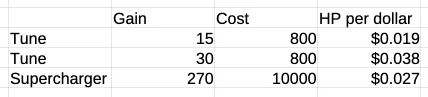
30 hp is a .2 or .3 reduction in e.t. and a 2-3 mph gain.

That's significant.

Then add another 30.

And another . . .

🤣
That makes sense, and I understand why people do it as a hobby, but after spending so much on incremental marginal improvement performance mods, it seems a supercharger that cuts 60-130 time in half is more bang for the buck.
Sponsored


Junkyard Dog

Well-Known Member
Joined
Jun 3, 2025
Threads
59
Messages
2,847
Reaction score
2,350
Location
Georgia
Vehicle(s)
2024 Dark Horse
That makes sense, and I understand why people do it as a hobby, but after spending so much on incremental marginal improvement performance mods, it seems a supercharger that cuts 60-130 time in half is more bang for the buck.
Depends on your goals.

I bought my Dark Horse to drive around to the grocery store. I also bought it to run on the track.

Adding a supercharger ruins the car for the track, because the car cannot come close to cooling off the heat produced by 875 horsepower (and no, I am not talking about IAT, I mean actual heat produced by the engine, BTU per horsepower, a huge chunk of which goes into the coolant and oil and has to be transferred to the air). It's not much fun doing one or two laps and then cruising along to cool off the engine.

Oil can be controlled pretty effectively with the aftermarket (the stock oil cooler won't cut it with a supercharger).

Coolant, however, cannot, at least not without major fabrication. Kenny G and Fluidyne, for instance, have S550 triple pass radiators, but not for the S650 (just like Ferodo does not make brake pads for the S650 yet). Maybe in the near future they will address this potential market.

Then I would probably go with turbos instead of a supercharger for the track, anyway, not driven off the crank, so more horsepower per psi, meaning less heat from compressed air transferred into the rings at the same horsepower level . . . and easier to turn down the boost from the driver's seat, too (although the Smoothboost controller may solve this for superchargers). And the rings are a worry if you are on a race track for 30 minutes with 4000-5000 foot full throttle runs over and over and over instead of a quarter mile and go cool down. This is why the forced induction short block has wider gaps in the rings.
 
Last edited:


Top