Sponsored

Whipple Calibration On Hold

Abilor

Well-Known Member
Joined
May 12, 2025
Threads
7
Messages
246
Reaction score
200
Location
Albany, NY
Vehicle(s)
2025 Mustang GT
update
got the orignal tune off with hp tuners
flashed the new whipple revision
but the new revision is not supported by hp tuners i selected the right controller and sent it in to them to get it supported.
You're a hero, sir.
Sponsored


Abilor

Well-Known Member
Joined
May 12, 2025
Threads
7
Messages
246
Reaction score
200
Location
Albany, NY
Vehicle(s)
2025 Mustang GT
I hope to be adding a Whipple next Spring/Summer, so I did some research on the HO Greens I have coming, since cooking those is not an option. Here's what I found elsewhere in the itnerwebbs:

1. Baseline: Why HO Green Cats Are a Smart Choice

Kooks “Green” High Output cats use a G-Sport metallic substrate, rated for supercharged or turbocharged applications up to ~900–1000 horsepower.

They’re designed to handle:
  • Higher exhaust mass flow and temperature (the metallic substrate has much higher thermal shock tolerance than the OEM ceramic).
  • Faster light-off and lower backpressure (the cell density is typically 300–400 cpsi versus OEM 600+ cpsi).
  • Better resistance to washcoat degradation (from richer AFRs under boost).
That means, compared with stock cats, HO Greens can survive EGT spikes of 1750–1850 °F routinely without melting or cracking, as long as the AFR and timing are managed properly.

In short: Under sane calibration and reasonable duty cycles, they should last a typical lifetime (tens of thousands of miles, not years of track-only abuse).

2. Why They Survive Where Stock Cats Don’t

MechanismStock CatsHO Green CatsResult
Substrate MaterialCeramic (cordierite)Metallic (FeCrAl foil)Higher thermal conductivity, resists melting
Cell Density600–900 cpsi300–400 cpsiLess restriction → lower post-combustion backpresure
Thermal Mass / CoolingLowHigh (metal foil radiates heat better)Cools faster betwen pulls
Chemical LoadCalibrated for stoichCompatible with richer WOTWon’t overheat from 11.5:1 AFR
Durability with BoostModerateExcellentTuned for FI exhaust energy

So: stock cats often crack or melt at sustained 1700 °F, while HO Greens routinely survive that.

The limiting factor becomes tune discipline and thermal management, not cat construction.

3. Quantitative Targets to Log


For your Whipple Stage 1 + Kooks HO Green + Gen IV Coyote, here are ideal safety bands to log and maintain:

ParameterSafe RangeWarning ThresholdCat Protection Rationale
AFR / Lambda @ WOT11.5 ± 0.2 : 1 (λ ≈ 0.78–0.80)Leaner than 12.0 : 1Lean combustion drives EGT skyward
EGT (pre-cat)≀ 1750 °F (950 °C)> 1800 °F sustainedThermal overload risk
IAT2 (post-intercooler)≀ 140 °F (60 °C)> 150 °F → pull timingHot air = detonation + richer trims
Timing advance @ WOT15°–18°> 19° with 93 octMore advance = more in-cylinder heat
Knock Retard0 °> 2 ° = reviewKnock → retarded spark → hotter EGT
LTFT/STFT± 5 %> 10 % driftImbalance = possible fueling / MAF error
O2 sensor voltagesRich (> 0.85 V) under boostLean (< 0.8 V)Confirms safe fueling
Cat Temp (if modeled)< 1650 °F (900 °C)> 1750 °FECU may trigger cat protection enrichment

If you see IAT2 climbing past 140 °F or EGT trending above 1750 °F on a long pull, lift off early or shorten pull duration. Those are your “cat saver” moments.

4. In-Tune Safeguards You Should Confirm or Add

Enable “Cat Over-Temp Protection” (COT):
  • In Ford’s PCM logic, COT adds fuel and retards timing when modeled cat temps exceed ~1650 °F. Verify this logic is intact in your Whipple tune.
Review Decel Fuel Cut (DFCO):
  • Sudden rich–lean transitions can shock the metallic substrate. Make sure DFCO ramps in smoothly.
Boost-based Enrichment:
  • Command richer AFR (≈ 11.3:1) above 7 psi, tapering leaner below 3 psi.
Gear-based Torque Limits:
  • Keep lower-gear torque limits active (like Whipple’s “Flight Control”) — reduces repeated full-load stress cycles.
Fuel Quality:
  • 93 octane minimum, or E30–E50 blends if possible; ethanol keeps EGTs down ~75 °F.
Intercooler System Health:
  • Monitor pump current and manifold temps. Whipple’s brick I/C must not heat-soak; consider upgraded heat exchanger and high-flow pump.
5. Long-Term Care Strategy
  • Data log after any firmware or seasonal change.
  • Heat and barometric pressure shift fueling and EGTs subtly.
  • Inspect cats yearly. Use an IR gun pre/post cat after a WOT pull; > 100 °F differential = healthy flow, < 50 °F may mean clogging.
  • Avoid long dyno sessions or stationary pulls. Metallic cats need airflow to shed heat.
  • Keep plugs and coils fresh. Misfires dump raw fuel into cats — their #1 killer.
Seems encouraging and sane...
 

ZXMustang

Well-Known Member
Joined
Oct 24, 2020
Threads
6
Messages
573
Reaction score
812
Location
tooner
Vehicle(s)
2025 ESS G3 Mustang GT
Fascinating stuff; do you have logs demonstrating this? Specifically, what was lambda commanded, lambda actual, and EGT "surge" pre- and post-DFCO engagement? What temp is a "lean" spike you're seeing, >1700F? 1750F?
This was observed by other folks like Greg Banish in street and race car applications. You wont see the temp spike because these are inferred temps and when logged will follow the calibration's temp directive for that given load/RPM.

I would have to go back and look at the logs I have on the last car with DFCO disabled. It does show richer than stoich commanded ,but spark is high at highRPM/very low load so you essentially get correct actual fueling on decel but with no lean spike and fuel cut, especially if you have to get right back on the gas for whatever reason and you are in a momentary lean condition and PE rates are stock or close to stock. That is where you have trouble because you are well over stoich and have to run back from 2.00 down to .85 or whatever PE condition you should be in when load shoots back up. PE fueling rates can be increased to help. But Ford has most of this very well set, so its like 6 of one or half dozen of another.

DFCO is helpful for fuel mileage and that's about it. For peak/safe/predictable power, you want it off. Another level to this would be turning off LTFTs. This puts the car into a condition where fueling is going to be as accurate as possible in real-time assuming maf/SD is all correct for your mechanical/fuel combination. If you are going to be beating a car on a track or on the street repeatedly, these are optimal for real-time correct fueling and temp control at any RPM/LOAD scenario.

All of these are my opinions - tested of course over hundreds of cars across 4 generations of coyotes now.
 

Abilor

Well-Known Member
Joined
May 12, 2025
Threads
7
Messages
246
Reaction score
200
Location
Albany, NY
Vehicle(s)
2025 Mustang GT
This was observed by other folks like Greg Banish in street and race car applications. You wont see the temp spike because these are inferred temps and when logged will follow the calibration's temp directive for that given load/RPM.

I would have to go back and look at the logs I have on the last car with DFCO disabled. It does show richer than stoich commanded ,but spark is high at highRPM/very low load so you essentially get correct actual fueling on decel but with no lean spike and fuel cut, especially if you have to get right back on the gas for whatever reason and you are in a momentary lean condition and PE rates are stock or close to stock. That is where you have trouble because you are well over stoich and have to run back from 2.00 down to .85 or whatever PE condition you should be in when load shoots back up. PE fueling rates can be increased to help. But Ford has most of this very well set, so its like 6 of one or half dozen of another.

DFCO is helpful for fuel mileage and that's about it. For peak/safe/predictable power, you want it off. Another level to this would be turning off LTFTs. This puts the car into a condition where fueling is going to be as accurate as possible in real-time assuming maf/SD is all correct for your mechanical/fuel combination. If you are going to be beating a car on a track or on the street repeatedly, these are optimal for real-time correct fueling and temp control at any RPM/LOAD scenario.

All of these are my opinions - tested of course over hundreds of cars across 4 generations of coyotes now.
Lots of food for thought. Thanks for sharing.
 

Junkyard Dog

Well-Known Member
Joined
Jun 3, 2025
Threads
54
Messages
2,563
Reaction score
2,067
Location
Georgia
Vehicle(s)
2024 Dark Horse
Would E85 help any of these catalytic converter issues?

If you are on a real track (not a drag strip) and might have 20 seconds or more of full throttle 875 horsepower application without backing off before standing on the brakes (and only seconds before getting back on the throttle), would E85 keep things cooler and help with not melting the expensive Green cats?


Abilor

Well-Known Member
Joined
May 12, 2025
Threads
7
Messages
246
Reaction score
200
Location
Albany, NY
Vehicle(s)
2025 Mustang GT
Would E85 help any of these catalytic converter issues?

If you are on a real track (not a drag strip) and might have 20 seconds or more of full throttle 875 horsepower application without backing off before standing on the brakes (and only seconds before getting back on the throttle), would E85 keep things cooler and help with not melting the expensive Green cats?
Off the cuff, yes, it would run cooler, with a higher volume of fuel overall at a much higher octane. Even with advanced timing, so long as AFR's are dialed in, I'd think it would be ok, though as ZXMustang mentioned, I'd worry about washing all the oil right off those cylinder walls. Racers run the stuff all the darn time without grenading, though, so surely there's ways. For track applications, I agree with ZXMustang that turning off DFCO and LTFTs with tightly-calibrated Speed Density air models would be the way to go. For street, I'm not convinced enough yet that I'd turn off DFCO, COT, etc. protections, but I'm also careful with a tight calibration, earlier PE enrichment when tipping-in to power, modest enhanced PE (0.82 to 0.84/0.85 commanded WOT lambda, and modest timing advancements where there's plenty of overhead between minimum threshold and engineer's peak/MBT.

My personal sense is that it's "whiplash" - switching suddenly from rich to lean, low to high load, etc. - that might be causing issues, which seems to come down to how the tuner anticipates tip-in, tip-out, protections logic, etc.
 

DRP Motorsports

Had A Few Stangs
Diamond Sponsor
Joined
Jan 14, 2018
Threads
42
Messages
220
Reaction score
186
Location
NC
Vehicle(s)
2017 GT350, 2019 GT, 2020 GT500
I recently spoke with a potential customer last week with a 24 Mustang with the Stage 1 warrantied Whipple setup on his car. His car has melted the cats twice according to him and he was looking into ridding the cats himself on account of this. The problem is he still has a warranty to maintain as well as emissions readiness test to pass. Passing emissions with a readiness monitor test really leaves you handcuffed as to what you can do in the tuning. I am glad we only have to pass a visual here where I live.
 

Junkyard Dog

Well-Known Member
Joined
Jun 3, 2025
Threads
54
Messages
2,563
Reaction score
2,067
Location
Georgia
Vehicle(s)
2024 Dark Horse
I recently spoke with a potential customer last week with a 24 Mustang with the Stage 1 warrantied Whipple setup on his car. His car has melted the cats twice according to him and he was looking into ridding the cats himself on account of this. The problem is he still has a warranty to maintain as well as emissions readiness test to pass. Passing emissions with a readiness monitor test really leaves you handcuffed as to what you can do in the tuning. I am glad we only have to pass a visual here where I live.
So does Whipple or Ford pay for the cats?
 

DRP Motorsports

Had A Few Stangs
Diamond Sponsor
Joined
Jan 14, 2018
Threads
42
Messages
220
Reaction score
186
Location
NC
Vehicle(s)
2017 GT350, 2019 GT, 2020 GT500

robvas

Well-Known Member
Joined
Mar 7, 2024
Threads
26
Messages
2,751
Reaction score
2,731
Location
MI
Vehicle(s)
2011 Mustang
If you are on a real track (not a drag strip) and might have 20 seconds or more of full throttle 875 horsepower application without backing off before standing on the brakes (and only seconds before getting back on the throttle), would E85 keep things cooler and help with not melting the expensive Green cats?
Do you know what mph you would end up at after 20 seconds of WOT? 7 seconds 60-130 then you have another 13 seconds to hit the speed limiter (if it's still there) or 180-190
 

Junkyard Dog

Well-Known Member
Joined
Jun 3, 2025
Threads
54
Messages
2,563
Reaction score
2,067
Location
Georgia
Vehicle(s)
2024 Dark Horse
Do you know what mph you would end up at after 20 seconds of WOT? 7 seconds 60-130 then you have another 13 seconds to hit the speed limiter (if it's still there) or 180-190
No idea. Twenty seconds was just a wild guess.

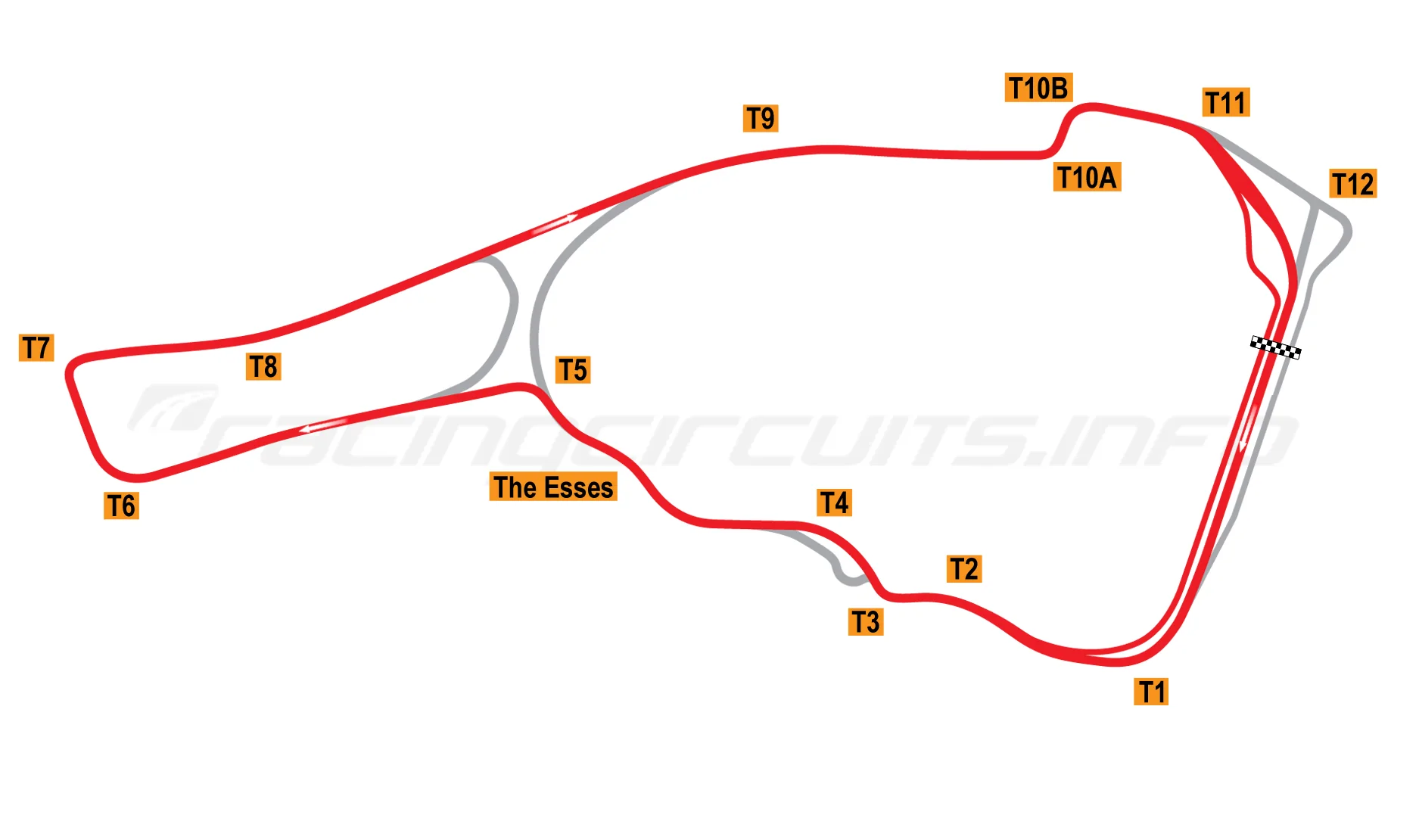
I had in mind something like Michelin Road Atlanta, from Turn 7 to Turn 10A. Turns 10A and 10B are the chicane that they added way back when because the really fast cars were bottoming out at the bottom of a hill before proceeding uphill at over 200 mph, and the downforce from aero and speed and G force from being in the bottom of a U shape, was shredding tires at the bottom of the U. So the solution was to take the big, wide "straight" from Turns 7 through to Turn 11 - what is today Turn 11 - and narrow down the track at the bottom of the hill and make a 90 degree, narrow left turn at the bottom of the hill (10A), then an almost immediate right hand turn to start back uphill (10B).

The track is uphill from turn 7 to turn 9 and then peaks after turn 9, going downhill toward turn 10A. You still have the throttle matted to the floor proceeding downhill until it is time to brake for Turn 10A, where the big wide track suddenly narrows and turns hard, 90 degrees left. There is a huge gravel runoff there at 10A for the cars that go straight off track instead of turning left.

Most HPDE guys coast over the hill and down.

My stock Dark Horse was over 130 mph prior to turn 9, but my instructor had asked for a cap of only 120 mph in the morning and then raised it to 130mph later in the day, so I was doing the same, staying part throttle to maintain 130mph or so. A C7 Z06 Corvette that was solo on the track with me that day had to be well over 140 mph cresting the hill after Turn 9.

S650 Mustang Whipple Calibration On Hold 1762449963259-k3


I do not know how long it would take to go from Turn 7 to Turn 10A with a Whipple supercharger, but 60-130 times on some flat surface somewhere are not going to answer the question. First, you are not going to be anywhere near 60 mph (100 kph) exiting Turn 7. Second, it is uphill once you are able to get on the throttle fully. Third, you will have a hot engine at this point, so you will not be getting full advertised horsepower like your perfectly timed 60-130 flat highway run for bragging rights. Fourth, staying on the throttle through Turn 9 and downhill toward Turn 10A is probably going to be well over 140 mph even on a stock Dark Horse - like I said, my instructor had not loosened the reins on this particular horse on day 1 over 130 mph, so I was part throttle at that point maintaining speed around 130 mph up over and down that hill.

Twenty seconds may not be right, but it is going to be a lot more heat generated on this track than ripping a quarter mile at a time and going back to the pits to cool off.
 
Last edited:
OP
OP
needforspeedirl

needforspeedirl

Well-Known Member
Joined
Aug 21, 2025
Threads
12
Messages
166
Reaction score
146
Location
In Front of You
Vehicle(s)
2024 Mustang RTR Spec 2
No idea. Twenty seconds was just a wild guess.

I had in mind something like Michelin Road Atlanta, from Turn 7 to Turn 10A. Turns 10A and 10B are the chicane that they added way back when because the really fast cars were bottoming out at the bottom of a hill before proceeding uphill at over 200 mph, and the downforce from aero and speed and G force from being in the bottom of a U shape, was shredding tires at the bottom of the U. So the solution was to take the big, wide "straight" from Turns 7 through to Turn 11 - what is today Turn 11 - and narrow down the track at the bottom of the hill and make a 90 degree, narrow left turn at the bottom of the hill (10A), then an almost immediate right hand turn to start back uphill (10B).

It is uphill from turn 7 to turn 9 and peaks, then goes sharply downhill, where you still have the throttle matted to the floor until it is time to brake for Turn 10A, where the big wide track suddenly narrows and turns hard, 90 degrees left.

Most HPDE guys coast over the hill and down.

My stock Dark Horse was over 130 mph prior to turn 9, but my instructor had asked for a cap of 120 mph in the morning and then raised it to 130mph later in the day, so I was doing the same. A C7 Z06 Corvette that was solo on the track with me that day had to be well over 140 mph cresting the hill after Turn 9.

1762449963259-k3.webp


I do not know how long it would take to go from Turn 7 to Turn 10A with a Whipple supercharger, but 60-130 times on some flat surface somewhere are not going to answer the question. First, you are not going to be anywhere near 60 mph (100 kph) exiting Turn 7. Second, it is uphill once you are able to get on the throttle fully. Third, you will have a hot engine at this point, so you will not be getting full advertised horsepower like your perfectly timed 60-130 flat highway run for bragging rights). Fourth, staying on the throttle through Turn 9 and downhill toward Turn 10A is probably going to be well over 140 mph even on a stock Dark Horse - like I said, my instructor had not loosened the reins on this particular horse on day 1 over 130 mph, so I was part throttle at that point maintaining speed around 130 mph up over and down that hill.

Twenty seconds may not be right, but it is going to be a lot more heat generated on this track than ripping a quarter mile at a time and going back to the pits to cool off.
I have the Roush phase 2 which is supposed to be “mild” and I still have felt the car detune the power after 3-4 minutes of reckless hooning on the streets in cool weather. I’m doing LTH catless headers soon.
 

135Hoser

Well-Known Member
Joined
Feb 20, 2020
Threads
10
Messages
233
Reaction score
266
Location
Canada
Vehicle(s)
2024 Dorkhorse, 2024 CR-V
I got my car back from having the drivers side cat replaced under warranty, just in time for winter.

has anyone done a before/after dyno with the new calibration from Whipple? Just curious how they're keeping the peak power the same if they took timing out of it, or adjusted the cat overtemp parameters.
 

Billycar11

Well-Known Member
Joined
Apr 23, 2024
Threads
1
Messages
395
Reaction score
326
Location
USA
Vehicle(s)
2024 Dark Horse, 2007 Pontiac Grand Prix
I got my car back from having the drivers side cat replaced under warranty, just in time for winter.

has anyone done a before/after dyno with the new calibration from Whipple? Just curious how they're keeping the peak power the same if they took timing out of it, or adjusted the cat overtemp parameters.
im still waiting on hp tuners to index the new whipple update sent it in on 28th of October they said they would email me when its supported
Sponsored


Top