Redback
Well-Known Member
- Thread starter
- #1
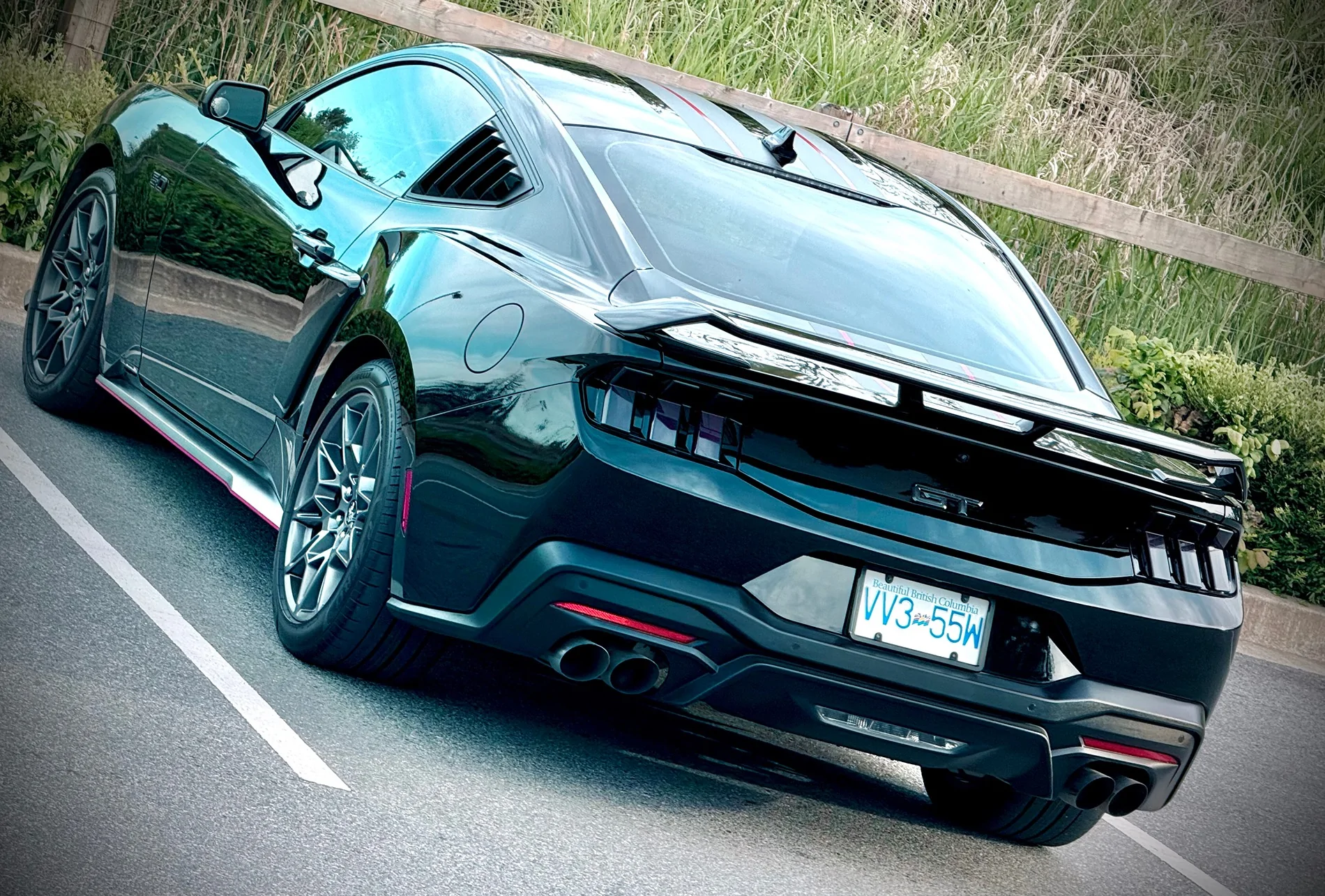
So I installed tinted tail light covers today.
After a lot of research I realized I had completely overlooked one of the most powerful performance upgrades available to Mustang owners: tinted tail lights. I discovered that when installed, they become advanced “aerophotonic modulators” that initiate a cascade of scientifically ambiguous processes that measurably increase horsepower.
I Googled what the experts refer to as Rearward Luminal Compression (RLC). It turns out that untinted tail lights scatter unregulated photons in all directions, creating chaotic light turbulence behind the vehicle. This turbulence interferes with the laminar flow of particles around the car. By tinting the lights, the photon emissions are slowed and compressed into a denser beam of high-performance darkness, dramatically stabilizing the vehicle’s wake.
Once stabilized, the car enters a state known as Optical Drag Reduction (ODR). Darkened tail lights absorb stray red-spectrum photons that would otherwise bounce off nearby pavement, buildings, and the occasional pedestrian. These photons are converted through a process called Photo-Thermo-Equine Conversion, where excess light energy is transformed directly into additional horses inside the engine. Performance experts refer to these as Spectral Horsepower Units (SHU).
Incredibly, testing in highly questionable wind tunnels has demonstrated that every 10% increase in tail light tint density produces approximately 3–7 phantom horsepower, depending on atmospheric pressure levels and the driver’s sunglasses.
There is also a psychological component known as the Observer Intimidation Coefficient (OIC). When other motorists see the darkened rear lights of a Mustang ahead of them, their brains subconsciously interpret the vehicle as moving faster than it actually is. This creates a localized relativity effect in which the car effectively gains speed simply by comparison.
What’s really cool is that the tinted lenses act as Equine Resonance Chambers, harmonizing with the engine’s combustion pulses. At exactly 3,500 RPM, the tail lights begin oscillating at a frequency that aligns with the natural vibration of imaginary horses, encouraging them to run harder.
I know traditional upgrades like a supercharger or exhaust system add significant measurable power, but if you’re looking for an edge, tinted tail lights leverage aerophotonic science to unlock the Mustang’s true potential: horsepower derived from darkness itself.
And they look great.
Long live the darkness.

After a lot of research I realized I had completely overlooked one of the most powerful performance upgrades available to Mustang owners: tinted tail lights. I discovered that when installed, they become advanced “aerophotonic modulators” that initiate a cascade of scientifically ambiguous processes that measurably increase horsepower.
I Googled what the experts refer to as Rearward Luminal Compression (RLC). It turns out that untinted tail lights scatter unregulated photons in all directions, creating chaotic light turbulence behind the vehicle. This turbulence interferes with the laminar flow of particles around the car. By tinting the lights, the photon emissions are slowed and compressed into a denser beam of high-performance darkness, dramatically stabilizing the vehicle’s wake.
Once stabilized, the car enters a state known as Optical Drag Reduction (ODR). Darkened tail lights absorb stray red-spectrum photons that would otherwise bounce off nearby pavement, buildings, and the occasional pedestrian. These photons are converted through a process called Photo-Thermo-Equine Conversion, where excess light energy is transformed directly into additional horses inside the engine. Performance experts refer to these as Spectral Horsepower Units (SHU).
Incredibly, testing in highly questionable wind tunnels has demonstrated that every 10% increase in tail light tint density produces approximately 3–7 phantom horsepower, depending on atmospheric pressure levels and the driver’s sunglasses.
There is also a psychological component known as the Observer Intimidation Coefficient (OIC). When other motorists see the darkened rear lights of a Mustang ahead of them, their brains subconsciously interpret the vehicle as moving faster than it actually is. This creates a localized relativity effect in which the car effectively gains speed simply by comparison.
What’s really cool is that the tinted lenses act as Equine Resonance Chambers, harmonizing with the engine’s combustion pulses. At exactly 3,500 RPM, the tail lights begin oscillating at a frequency that aligns with the natural vibration of imaginary horses, encouraging them to run harder.
I know traditional upgrades like a supercharger or exhaust system add significant measurable power, but if you’re looking for an edge, tinted tail lights leverage aerophotonic science to unlock the Mustang’s true potential: horsepower derived from darkness itself.
And they look great.
Long live the darkness.
Sponsored