
Sponsored

Coyote Engine Advice

Jetfixer

New Member
Joined
Jun 19, 2026
Threads
1
Messages
1
Reaction score
0
Location
SW Ohio
Vehicle(s)
2025 Mustgang GT Priemum 401A 2017 F150 4WD Lariet 3.5 Ecoboost
Let me say first of all that I’ve been driving cars and trucks with manual transmissions for over 60 years. And yes I’m old. However the recent purchase of a very low mileage ’25 GT is my first experience with a computer controlled engine mated to a manual transmission. In the old days engines would protest loudly when lugged by pinging, knocking, shuddering, etc. However this new to me V8 seems to be very happy from almost idle to redline. I try to keep the rpm above 1500 unless it’s on a perfectly level stretch of road. And even then I’ll drop down a gear or 2 depending on terrain or circumstances. So, do I need to worry? Keep the rpm‘s even higher than the 1500 minimum I’ve set?
Sponsored
 

Skye

Well-Known Member
Joined
Jul 29, 2022
Threads
0
Messages
1,748
Reaction score
2,722
Location
≈39N
Vehicle(s)
"Skye" Mach1 N2144
I have a V8, Manual Transmission as well.

Lugging any engine is a valid concern. But I would not rely on an minimum RPM to help alleviate that.

There is a distinction from previous engine generations and today's. Years ago, it was left to the driver to determine if lugging was occurring and then to take action. In today's engines, lugging does still happen, but the computers take often action before the driver notices.

While modern systems act quickly and in the background, the physical events of Low Speed Pre-Ignition (LSPI) still occur. If the problem is bad enough, misfire events can be recorded, the car throwing a wrench light (engine issue, code/s recorded, take action). Long-term, the risk of damage is still there.

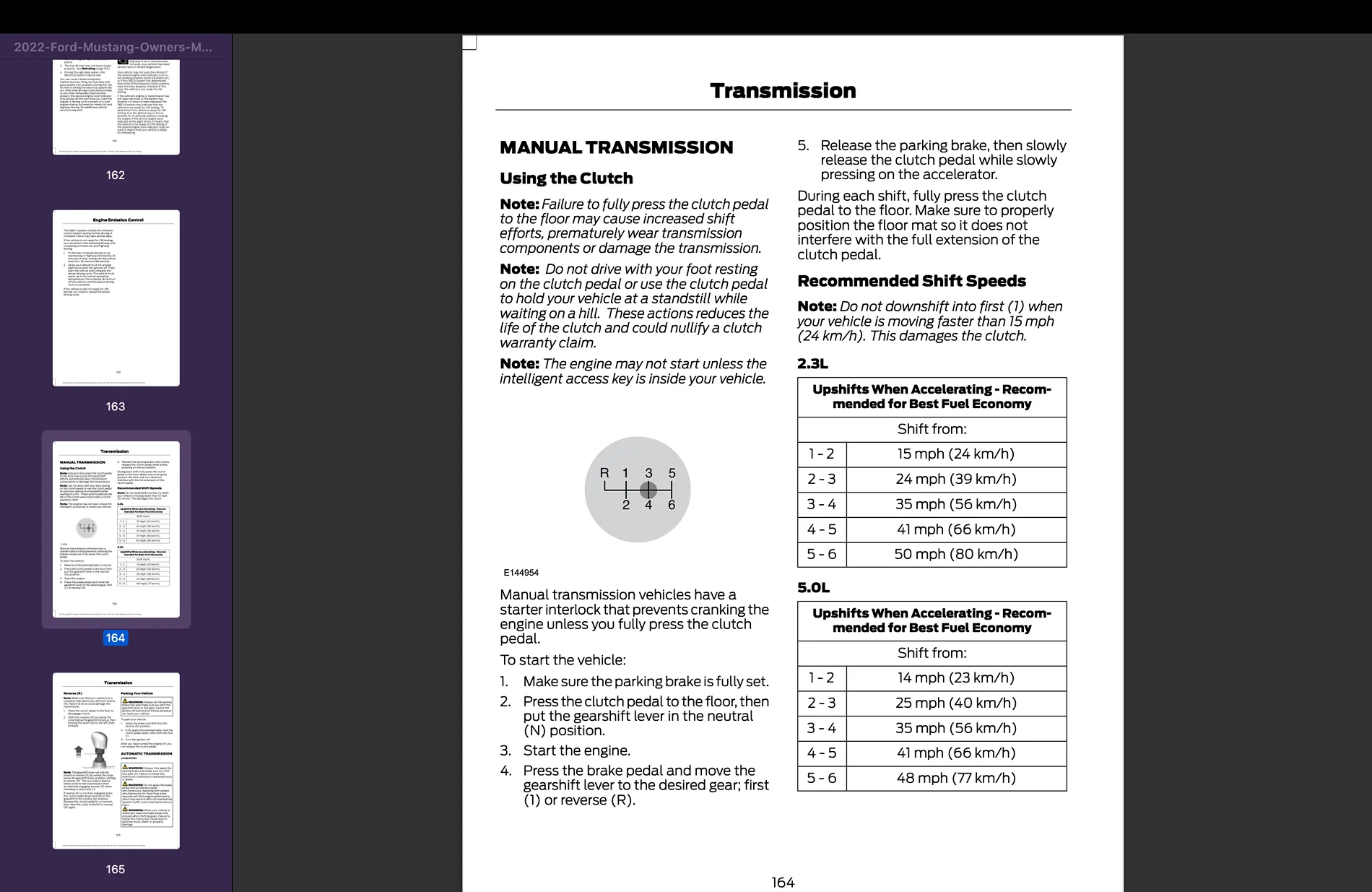
I looked in the 7G manual for shift recommendations for a Manual Transmission and couldn't find any. Looking at the 2022 owners manual, there are some (attached). These are based on speed and not RPM. I think anyone could use these as an initial basis for regular driving in town. These are guidelines and not hard rules. Notice these are also mentioning fuel economy.

While I have a performance shift indicator alarm set, that's for when I'm wringing out the car. When I'm driving the vehicle in a normal manner I rely on the sound of the engine and feel of the car to determine when to shift. IDK, it's just something I do. As with other cars, you'll develop your senses when it's best to shift this car.

If the vehicle is struggling and under-responsive, I know I need to go down a gear. If I look at the tach and it's above 3,500 RPM while driving normally in traffic, I go up a gear. Shifting...on average, I probably make shifts around 3,500 - 4,000 RPM. The car is not struggling, but not wailing either. It's a behavior where I'm not looking at the tach. From feel, sound and experience, I just know when's a good time to shift. The times I have been found lugging, it's often on a new stretch of road I'm not familiar with.

When starting off, it takes a bit of time before the engine is warmed up and temperatures are stable. In these instances, I keep RPMs below 4,000. There's no official reference for that. It's an RPM I've felt is good to move around with, without stressing the engine while being warmed.

If I've started the car after a stop, I'l look at the engine temp. It'll often be higher that usual, sitting with no use of fans or airflow. In these examples, I'll drive similarly to the paragraph above. Easy on the engine until temps return to normal.

Driving in traffic, steady speed and cruising, I'm probably at 2,500 RPM. If I'm pushing the car, anticipating winding the engine up and moving, 3,500 RPM. My engine comes alive about 4,000 and higher.

Those are some general ideas. I'd move away from an RPM operating floor and rely on how the car is behaving, sounds and acts.

The Coyote likes to rev. Don't be surprised if the car is driving well and the RPMs seem higher than they would with other vehicles. Compared to my Mustang, driving my truck is like driving a tractor: operating RPMs are much lower.

Another thing you can do to support this is use a quality Top Tier fuel, the highest octane you can find. The higher the octane, the greater spark advance and power. But it also helps in another way: reduces the risk of LSPI by increasing the point at which the fuel could spontaneously ignite.

https://www.toptiergas.com/

S650 Mustang Coyote Engine Advice Screenshot 2026-08-03 at 02.02.56
 
Last edited:


Top