Sponsored

Aussie S650 Paint protection and detailing thread

DFB5.0

Well-Known Member
Joined
Mar 15, 2017
Threads
38
Messages
1,496
Reaction score
2,101
Location
Australia
Vehicle(s)
Mustang GT Fastback
FYI....

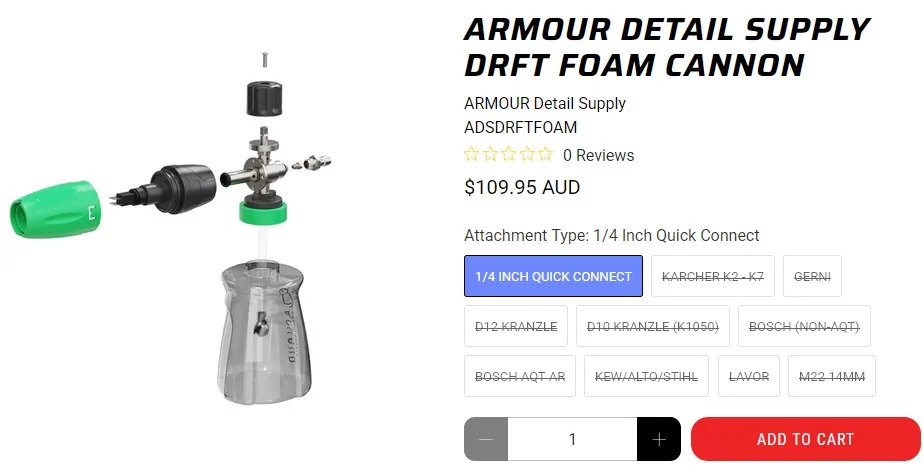
Armour Detail Supply now have a foam canon.

https://detailingshed.com.au/products/armour-drft-foam-cannon?variant=48668840689879

ADS-Canon.webp


Probably the biggest let down is the bottle, being PET plastic.
When it comes to the "drop test", PET is not the worst, but not the best either.

From Google AI:

When choosing or using a snow foam cannon for car washing, the bottle material determines whether it will survive a drop onto concrete.

Clear, rigid plastic foam cannon bottles (typically made of Polycarbonate or Acrylic) are highly prone to cracking or shattering when dropped. [1, 2, 3]
The durability of common foam cannon bottle plastics varies significantly when subjected to a drop:


High Risk: Clear Rigid Plastics (Polycarbonate / PC, Acrylic, or low-grade PETG)
  • Performance: Very poor impact resistance.
  • Why they crack: These plastics are chosen because they are crystal clear, allowing you to see the soap level perfectly. However, they are incredibly brittle. When dropped onto a driveway—especially when filled with 1 litre of water—the plastic cannot flex to absorb the shock. They frequently shatter or crack cleanly across the base or where the heavy brass manifold meets the neck. [1, 2, 3, 4]

Medium Risk: Standard PET / Thick Polyethylene Terephthalate
  • Performance: Moderate impact resistance.
  • Why they crack: Clear or "smoked" PET bottles (like the ARMOUR DRFT Replacement Bottle) are much tougher than polycarbonate. They will easily survive a 1-metre drop if they are empty or half-full. However, because a foam cannon has a heavy brass head, dropping a completely full PET bottle can still cause a starburst crack at the base or split the threads if it lands awkwardly. [1, 2, 3]

Low Risk: Polypropylene (PP)
  • Performance: High impact resistance.
  • Why they resist cracking: This semi-flexible, translucent plastic is used in premium upgrades (such as the updated MJJC Foam Cannon PRO V3). Polypropylene naturally bends and deforms under stress, acting like a shock absorber when it hits the ground, making it highly crack-resistant. [1, 2]

No Risk: High-Density Polyethylene (HDPE)
  • Performance: Maximum impact resistance.
  • Why they resist cracking: HDPE is the milky-white, opaque plastic used in heavy-duty commercial bottles (like the 1L HDPE Foam Cannon Bottle). In drop tests, full HDPE bottles can be dropped from shoulder height or higher repeatedly without cracking. At most, they will scuff or slightly dent, but they will virtually never split or shatter. [1, 2, 3, 4, 5]


Which reminded me of this video, 2 years old now:


Avoid canons with a clear bottle! :lipssealed:
Same with buckets.
Sponsored


5.0ALM

Well-Known Member
Joined
Oct 31, 2022
Threads
98
Messages
1,280
Reaction score
2,144
Location
Brisbane, Australia
Vehicle(s)
2016 RAV4 Cruiser, 2024.50 Mustang GT Fastback
I unsubscribed from Pan the Advertiser not long after that Awards video.
(If you're into detailing, you'll know. :facepalm: )

However, he popped up on my suggested videos list totally out of the blue recently.

For anyone new to detailing, and specifically foam canons , this is actually worth the watch.
(There, I said it! :bandit:)

Ignore the click-bait title, treat it as Foam Canons 101.


And now I've watched that, another one of his pops up.
This one certainly piqued my interest, because I have never been happy with the haze on my Mustang's windscreen. I even brought this up at the 12 months service, but the dealer fobbed it off saying it's just the dash reflection. BS, considering it's hazy in the upper corners where there is no reflection.

That new car smell from the off-gassing has long gone, but the haze still continues to annoy me to this day.

I'm going to give this a go.
With close substitutes if I cannot find the exact products Pan is using.


Thoughts?
 

DFB5.0

Well-Known Member
Joined
Mar 15, 2017
Threads
38
Messages
1,496
Reaction score
2,101
Location
Australia
Vehicle(s)
Mustang GT Fastback
I unsubscribed from Pan the Advertiser not long after that Awards video.
(If you're into detailing, you'll know. :facepalm: )

However, he popped up on my suggested videos list totally out of the blue recently.

For anyone new to detailing, and specifically foam canons , this is actually worth the watch.
(There, I said it! :bandit:)

Ignore the click-bait title, treat it as Foam Canons 101.


And now I've watched that, another one of his pops up.
This one certainly piqued my interest, because I have never been happy with the haze on my Mustang's windscreen. I even brought this up at the 12 months service, but the dealer fobbed it off saying it's just the dash reflection. BS, considering it's hazy in the upper corners where there is no reflection.

That new car smell from the off-gassing has long gone, but the haze still continues to annoy me to this day.

I'm going to give this a go.
With close substitutes if I cannot find the exact products Pan is using.


Thoughts?
Well, that’s 27 minutes of my life I wont get back! :giggle:

The title of the foam cannon video is indeed click bate, he would never suggest a foam cannon is useless when he sells 3 foaming soaps, of which are sold alongside countless others in the THOR group. The main takeaway from that video is the following quote –

“Foam is the delivery system”.

As for the glass cleaning method, these are my thoughts on it, just things to be aware of –

- I wouldn’t be using that glaze product on tinted windows. Many years ago I used Autoglym Glass Polish, which was safe for interior and exterior surfaces. I actually quite liked it, you won’t be removing scratches with it, but it certainly deep cleans and creates a lovely clear finish. But the instructions caution the following, which Pan also highlighted in the video -

Note: Not suitable for aftermarket tinted windows.

So, for anyone with window tint film, you’d only be able to do the front windscreen with that method (or the Autoglym).

- That Koch Chemie glass cleaner he is recommending is a non-alcohol-based product that actually contains a gloss enhancer that they use in their quick detailers. So, he is basically mixing two similar products.

“Koch Chemie (GC) Glass Cleaner Pro is a ready to use, non-alcohol based glass cleaner. Even though it’s a glass cleaner, it can be used on a wide variety of sensitive surfaces such as plastics, dashboard screens, buttons, piano black surfaces and all other sensitive surfaces that a traditional alkaline based cleaner would damage."

KCx also mention it adds "a protective glossy finish to your glass".

The takeaway - don’t go and buy those specific products based on Pan's repurposed recommendations, chances are you already have something similar.
 

5.0ALM

Well-Known Member
Joined
Oct 31, 2022
Threads
98
Messages
1,280
Reaction score
2,144
Location
Brisbane, Australia
Vehicle(s)
2016 RAV4 Cruiser, 2024.50 Mustang GT Fastback
So, for anyone with window tint film, you’d only be able to do the front windscreen with that method (or the Autoglym).

The takeaway - don’t go and buy those specific products based on Pan's repurposed recommendations, chances are you already have something similar.
It's only the windscreen haze that bothers me, specifically the inside of the windscreen.
I would have thought outgassing would have come to an end after 18+ months, but perhaps not, being a garage queen with windows up. Sometimes not opened up for 1-3 weeks.


With glass cleaners, I did ask Gemini about a comparison:

Stoner Invisible Glass and Koch Chemie Glass Cleaner Pro are both exceptional choices, but they serve different needs. Stoner is an inexpensive, highly accessible workhorse that powers through heavy grime. Koch Chemie is a slick, premium formula that leaves a glossy, dust-repellent finish favored by professional detailers. [1, 2, 3, 4, 5]

Stoner's Invisible Glass
  • Performance: Features a highly concentrated, ammonia-free formula that easily cuts through interior haze, smoke residue, and oily contaminants. [1, 2]
  • Accessibility & Value: Widely available in both aerosol and liquid trigger spray bottles. It is highly cost-effective, often running about $6 USD for a 19-ounce can. [1, 2]
  • The Trade-off: The strong cleaning power means it lacks lubrication, sometimes causing a "draggy" feel on the glass during the wipe-down. This requires a quality microfiber towel to avoid lint or streaking. [1, 2, 3, 4]

Koch Chemie Glass Cleaner Pro (Gc)
  • Performance: A professional-grade, ready-to-use cleaner. It is highly slick and lubricates the glass beautifully, allowing your towel to glide effortlessly for a streak-free shine. [1, 2, 3]
  • Finish: Leaves behind a smooth, anti-static property that actively repels dust from settling on your freshly cleaned windows. [1]
  • Accessibility & Value: Pricier and less accessible than Stoner, usually requiring purchase through specialized automotive detailing suppliers (e.g., 5-liters typically cost around $85 USD)


we then bring haze into the conversation....


If Stoner's Invisible Glass did not remove the windscreen haze, the contamination is either chemical etching, baked-on mineral deposits, or stubborn silicone/grease buildup that standard liquid cleaners cannot dissolve. [1]
To completely clear this stubborn film, you must switch from a chemical spray cleaner to a mechanical glass polish or a deep-cleaning abrasive stripping compound.

Step 1: Deep Clean and Strip the Glass
Standard glass cleaners only sit on the surface. You need an abrasive glass polish to mechanically scrub off the bonded layer of haze. [1]

Cerium Oxide Polish: This is the gold standard compound used by professionals to polish glass. It physically shaves away micro-contamination without scratching the windscreen. [1, 2]


A highly effective, ready-to-use cerium oxide glass polish. It is specifically formulated to safely scrub away severe water spots, old wiper coatings, and traffic film that chemical sprays leave behind. [
1, 2, 3]


An incredibly user-friendly Japanese detailing product. It combines small abrasive particles with a built-on felt applicator head, making it incredibly easy to scrub the windscreen by hand without needing extra polishing pads.


Step 2: Use the Right Mechanical Agitation
Your choice of towel or pad matters just as much as the chemical compound when dealing with baked-on haze.


Glass Polishing Pads: If using a liquid polish like CarPro Ceriglass, use a dedicated rayon or felt glass polishing pad rather than a standard foam microfiber pad. Rayon provides the necessary friction to cut through stubborn haze. [
1]


ChatGPT reckons:


A persistent haze on a 2024 Mustang windscreen is fairly common, especially if it's on the inside. The source determines how to remove it.

First, identify where the haze is

Try this simple test:

  • Wipe a small area on the inside with a damp microfiber.
  • If the clear patch follows your wiping, the haze is on the inside.
  • If nothing changes, repeat on the outside.

Also look through the windscreen at night:

  • Milky glow around headlights usually indicates an oily film.
  • Tiny sparkling dots can indicate water spots or pitting on the outside.
If it's on the inside (most likely)

New cars release plasticizers (VOC outgassing) from the dashboard, which leaves a stubborn oily film on the glass.


I'd use this process:
  1. Wipe with a damp microfiber to remove dust.
  2. Spray Stoner Invisible Glass onto the towel (not directly onto the glass).
  3. Scrub firmly in overlapping passes.
  4. Immediately buff with a second clean, dry glass microfiber.
  5. Repeat 2–3 times if needed.

If the film is particularly stubborn, use a 50/50 mix of isopropyl alcohol (IPA) and distilled water first, then finish with Stoner.


------------------------------

Every so often I will treat the windscreen outside with P&S Clarity Creme.

After my first use of Clarity Creme, I decided I'd do this before the final rinse - ask me why!
(Being left with small pink residue particles on the scuttle is hard to avoid - necessitating a rinse away)

I then asked ChatGPT about using it on the inside of the windscreen to address the haze, something I have absolutely avoided because of the PITA residue ....


Yes—I actually think P&S Clarity Creme is a very good choice in your situation.


The key point is that ordinary glass cleaners don't remove everything. On a 2024 Mustang, the haze is often a combination of:

  • dashboard outgassing (plasticizers),
  • silicone from interior dressings,
  • skin oils,
  • nicotine (if applicable), and
  • airborne contaminants that have baked onto the glass.

Once that film has been repeatedly heated by the sun, it can become surprisingly stubborn.

Why Clarity Creme may work

Clarity Creme isn't just a cleaner—it contains very mild polishing abrasives along with chemical cleaners. It removes contamination that spray glass cleaners leave behind.


Importantly, it's not aggressive enough to damage automotive laminated glass when used by hand.

This is the process I'd use

  1. Wash the microfiber first.
    • Use two or three dedicated glass towels that have never seen wax or detailing spray.
  2. Apply P&S Clarity Creme
    • Work a section about 30 Ă— 30 cm.
    • Use moderate pressure.
    • Rub until the product almost disappears.
    • Don't just wipe it on and off.
  3. Buff off thoroughly.
  4. Follow immediately with Stoner Invisible Glass
    • Spray onto the towel, not the glass.
    • Wipe.
    • Buff dry with a second towel.

That combination often produces a noticeably clearer windscreen than either product alone.

If the haze returns after a week...

That's actually an important clue.


If it comes back within days or weeks, it usually isn't because you failed to clean it. It's because the dashboard is still outgassing, which is very common during the first couple of years of ownership—especially in Australia's heat.


The 2024 Mustang's steeply raked windscreen sits directly above a large soft-touch dashboard, making any outgassing film particularly noticeable when driving into the sun.

If Clarity Creme doesn't solve it

The next step I'd try would be CarPro Ceriglass by hand.


Ceriglass contains cerium oxide, so it's a stronger glass polish than Clarity Creme. It can remove contamination that survives normal cleaners, though it's still intended for glass and is commonly used by detailers. I wouldn't start with it unless Clarity Creme fails because it's more work and more aggressive.


--------------------

As Deyon mentions in his "Little Black Book of Detailing", CeriGlass is heavy duty.


Anyway, the point of all of this.... watching Pan lay down the large towels on top of the dash provided the epiphany moment to try what I already have, the P&S Clarity Creme on the inside of the windscreen.

I'll at least try this on a small section in front of the driver's position.
If the residue mess can be contained and/or easily removed with the vacuum, I will do the entire windscreen. :fingerscrossed:


I 99% love my Mustang.
That 1% failing is the persistent windscreen haze. :facepalm:
 

DFB5.0

Well-Known Member
Joined
Mar 15, 2017
Threads
38
Messages
1,496
Reaction score
2,101
Location
Australia
Vehicle(s)
Mustang GT Fastback
I did the Ceri-Glass (cerium oxide) thing once and it was a nightmare. Only use that if you 100% have to, its basically the sledgehammer and is highly abrasive to paint and rubber, a nightmare to wipe off, and needs supplemental lubrication to keep it from heating up/drying up.


Deano1978

Well-Known Member
Joined
May 20, 2023
Threads
4
Messages
403
Reaction score
412
Location
NSW
Vehicle(s)
Atlas Blue S650 GT with Black pack and Magneride
Hi Guys,

Got a question for the table of knowledge. My car has PPF and Ceramic on the panels, and ceramic on the windows and wheels. The PPF/coatings are about 18mths old.

The PPF is Xpel and ceramic is IGL.

About 3 mths ago I noted that the paint surface was quite rough after washing and my windscreen has what I can only describe as "glitter" effect seen from the inside when the sun is shining directly on it.

Are these typical signs of a ceramic coating that has failed? It was nice and slick when I first picked it up so I don't think it's an install issue.

The only other explanation I have for the rough surface and glitter effect is that about a month b4 I noticed it I was washing the car and my neighbours gardener decided to start blowing dust and shit in my direction while I was drying it off. I quickly hosed it down and redryed it. Is it possible the dust has somehow "baked" itself into the ceramic coating or got past the ceramic and is now in the PPF? I've washed it several times since this incident and it hasn't budged, still rough. It seems to be all over the car, not just a particular spot, but the dust did go all over the car.

I don't use foam cannons, would foaming it help get rid of the crap or will I need to decontaminate the paintwork or worse (polish the ceramic off and try not to damage the PPF)

Does decontaminating ceramic coatings remove or damage them requiring re application?
 
Last edited:

DFB5.0

Well-Known Member
Joined
Mar 15, 2017
Threads
38
Messages
1,496
Reaction score
2,101
Location
Australia
Vehicle(s)
Mustang GT Fastback
Hi Guys,

Got a question for the table of knowledge. My car has PPF and Ceramic on the panels, and ceramic on the windows and wheels. The PPF/coatings are about 18mths old.

The PPF is Xpel and ceramic is IGL.

About 3 mths ago I noted that the paint surface was quite rough after washing and my windscreen has what I can only describe as "glitter" effect seen from the inside when the sun is shining directly on it.

Are these typical signs of a ceramic coating that has failed? It was nice and slick when I first picked it up so I don't think it's an install issue.

The only other explanation I have for the rough surface and glitter effect is that about a month b4 I noticed it I was washing the car and my neighbours gardener decided to start blowing dust and shit in my direction while I was drying it off. I quickly hosed it down and redryed it. Is it possible the dust has somehow "baked" itself into the ceramic coating or got past the ceramic and is now in the PPF? I've washed it several times since this incident and it hasn't budged, still rough. It seems to be all over the car, not just a particular spot, but the dust did go all over the car.

I don't use foam cannons, would foaming it help get rid of the crap or will I need to decontaminate the paintwork or worse (polish the ceramic off and try not to damage the PPF)

Does decontaminating ceramic coatings remove or damage them requiring re application?
Switching to a foam cannon won't solve this, primarily because its a delivery method rather than a process.

I think in this situation you are dealing with contamination of some sort. The dust alone won't have baked into the PPF or glass without water and heat, then left to dry. That would be classified as mineral deposits. Iron contamination is a strong possibility, likewise sap.

Do you live near an airport or in a city area, or perhaps work/park near a railway? Or has there been fresh road line painting in your area?

If you haven't been able to shift this material with normal washing, the next step would be chemical intervention. I would be picking a test panel to find out what it takes to remove it, then step up in aggression until its gone. Once you find the method, expand to the rest of the car.

1. Wash with a low or high pH soap. Inspect.

2. Apply an iron remover, allow to dwell without drying, rinse. Inspect.

3. Use a water-spot remover. Follow the instructions for the chosen product, rinse, inspect.

With luck, you'll have it sorted without abrasion. If not, then unfortunately you'll have to step up from chemical to mechanical decontamination.

1. Use a synthetic clay towel/block/sponge/mitt and a clay lube. Because we are now abrading the surface, shrink your test spot to a 20x20cm section. Apply the lube, lightly work the section with the clay, then rinse and inspect. Apply no pressure, just let the clay glide.

2. If that doesn't work, then you'll need to step up to a real clay bar, repeating the same process. Again, be gentle.

Just be mindful you ideally want to avoid claying, especially at mid-term for the coating.

From there, I'm not sure what else would be required. If you want some additional reading on decontamination and what products I use, check out the article in the link below. Good luck and reach out if you need.

(3) Decontamination – What, Why, When & How
 

Deano1978

Well-Known Member
Joined
May 20, 2023
Threads
4
Messages
403
Reaction score
412
Location
NSW
Vehicle(s)
Atlas Blue S650 GT with Black pack and Magneride
Thanks DFB, I'll give all those a go and report back with what works.
 

DFB5.0

Well-Known Member
Joined
Mar 15, 2017
Threads
38
Messages
1,496
Reaction score
2,101
Location
Australia
Vehicle(s)
Mustang GT Fastback
Thanks DFB, I'll give all those a go and report back with what works.
Just be careful, PPF is another layer of complexity when it comes to maintenance and decontamination. If you are in doubt, consider talking to the installer of the PPF and coating.
Sponsored


Top