Sponsored

How Much HP Can a BAP Support

robvas

Well-Known Member
Joined
Mar 7, 2024
Threads
26
Messages
2,750
Reaction score
2,729
Location
MI
Vehicle(s)
2011 Mustang
I am not an engineer, but I am having trouble trying to figure out whether there is any relationship to exhaust system temperatures and the temperature of oil or coolant.
Combustion starts in the cylinder head and goes out the exhaust.

Coolant temperature comes (partially) from heat in the cylinder heads.

There are also people that say things like running e85 will cool the exhaust so you don't have worry about the stock cats when supercharged.
Sponsored
 

Skye

Well-Known Member
Joined
Jul 29, 2022
Threads
0
Messages
1,682
Reaction score
2,599
Location
≈39N
Vehicle(s)
"Skye" Mach1 N2144
I feel there is a direct relationship between combustion gas temperature and coolant/oil temps, but the amount of heat transferred from gas to coolant/oil is not much.

The spent fuel charge is a gas. Gases, being less dense than liquids, are not capable of transferring as much heat (energy) as a liquid can. See double-walled thermos, double-paned window glass.

Another factor to consider is how long the heated gases are in the chamber, before the next charge of cooler air and fuel enters. There's very little time for transfer to occur.

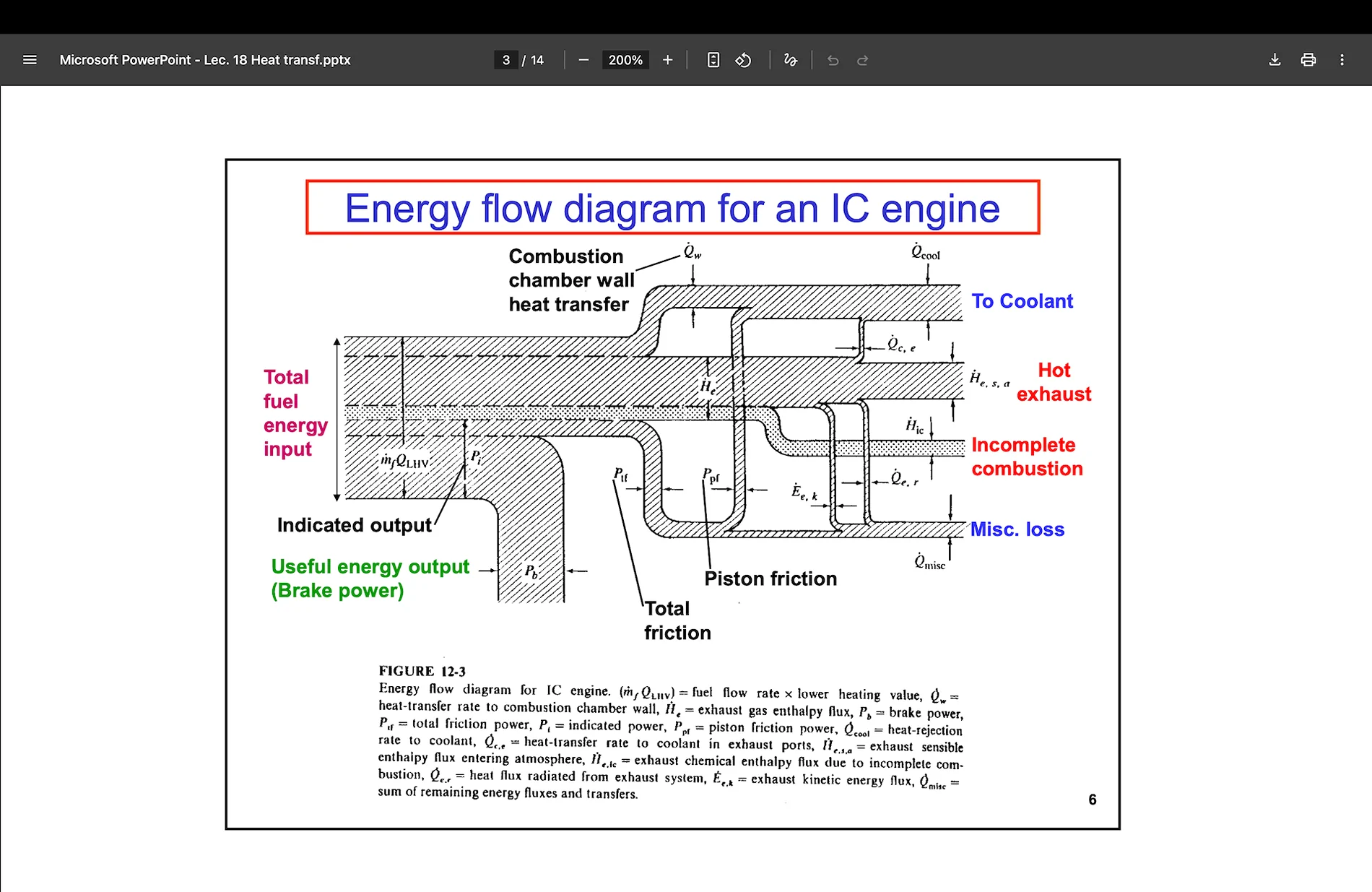
Attached is a slideshow from MIT. On page 3, chart 6, there is a slide displaying the possible energy output of a set amount of fuel and what happens in an engine. Overgeneralizing, 1/3 is usable energy, 1/3 is lost as heat exhaust gases, 1/3 is captured and carried away by the coolant and later radiator.

In the diagram is a link (Qc, e) between hot exhaust and coolant; it's a small amount of transfer. And that's a good thing. Considering the amount of heat in the gas, if it was transferred to the cylinder walls with greater efficiency, we'd have a serious overheating issue on our hands. Looking at that in reverse, if the chamber gases were cooler, while they would lower coolant and oil temperatures, it wouldn't be by much.


https://web.mit.edu/2.61/www/Lecture notes/Lec. 18 Heat transf.pdf

S650 Mustang How Much HP Can a BAP Support Screenshot 2025-12-03 at 14.13.12
 
Last edited:

Junkyard Dog

Well-Known Member
Joined
Jun 3, 2025
Threads
54
Messages
2,560
Reaction score
2,062
Location
Georgia
Vehicle(s)
2024 Dark Horse
Combustion starts in the cylinder head and goes out the exhaust.

Coolant temperature comes (partially) from heat in the cylinder heads.

There are also people that say things like running e85 will cool the exhaust so you don't have worry about the stock cats when supercharged.
I read online, however, that combustion temperature is "hundreds" of degrees lower. I do not know how they test that.

However, ethanol vaporizes at 172 degrees, way lower than gasoline, and vaporizing removes heat (this is how sweet cools off our bodies). I am pretty sure that ethanol is going to get hotter than that the moment our injectors spray it. Ethanol also removes 396 but per pound (gasoline is only 150).

I wish I could get some concrete numbers from actual experimentation. I have looked around on the internet and not found much. Somebody has to have done this experiment. I am not confident in what the Corvette guy wrote. He may not have been talking about track temps as opposed to driving around on public streets temps.
 

Junkyard Dog

Well-Known Member
Joined
Jun 3, 2025
Threads
54
Messages
2,560
Reaction score
2,062
Location
Georgia
Vehicle(s)
2024 Dark Horse
This guy Plimmer runs a twin turbo S550 on the track and keeps the boost to around 7-8 pounds on track days. He describes his never ending battle to bring temps down, but he seems to have finally done it.

BUT - here is the relevant thing. Somebody posted a broken piston. Plimmer had this to say:

e85 is essential, you will need this to keep piston temperatures down. The biggest issue with boost on an NA engine is the ring gaps are too tight, and after 15 min of hard running the ring ends will butt together and break the piston. Guy above already showed us this. Lol. So either pull the pistons out and open ring gaps for boost or run E85 as a compromise. I’ve done both on my car.​

https://www.mustang6g.com/forums/threads/superchargers-and-hpde-road-course.166186/page-2

So for those who are interested, I thought this was valuable additional information. E85 may not mean cooler coolant, but by cooling the piston it delays the time until the oil rings close all the gap.

I have to say this is one thing I had not previously considered.
 

Junkyard Dog

Well-Known Member
Joined
Jun 3, 2025
Threads
54
Messages
2,560
Reaction score
2,062
Location
Georgia
Vehicle(s)
2024 Dark Horse
Since then I did encounter a guy on TrackMustangs who ran a boosted (positive displacement blower) three valve Ford engine who said in his opinion, "Yes, e85 runs cooler. No debate about it. It also lets you run more ignition timing so you make more power. It’s also less than half the cost of 100 octane racing fuel so for that reason alone it’s worth `it in my opinion."

Link to that quoted post is here. A later equivocation, and the earlier bits of the thread from years ago complete with track time videos with the whine of the blower are all there (124 pages of thread)

#5,274

He runs a naturally aspirated, modern Coyote engine swap now, though.
Sponsored


Top